This past summer, I was extremely lucky to have the opportunity to travel to Thailand and teach a session of college level fish biology for a group of American high school students. Together, we trekked throughout the country from Bangkok to Koh Tao, Khao Sok, Koh Lanta, and Ayutthaya. I also had some time off to see the country without a group of teenagers trailing behind me and visited Chiang Mai, Pai, and Koh Chang. Throughout the course of the summer, I learned about a new marine ecosystem, a new country and culture, and a fair bit about myself. I rode elephants, went scuba diving, taught amazing students, participated in organic farming, and made new friends. But, of all these new and exciting experiences, the food (eating and cooking) may have been the most valuable and enduring.
Before going to Thailand, I loved Asian food and enjoyed eating at Thai restaurants in particular - I was really looking forward to having Thai food day in and day out, all summer long. I especially appreciate Thai food for the curries with coconut milk instead of cow's milk. Curries are undoubtedly my favorite meal to consume, but when eating out at Indian restaurants, I always worry about cream and ghee. At Thai food restaurants, I do consider how much chicken stock I am ingesting in "vegetarian" dishes, but at least I know I am safe from dairy. I love all the vegetables and spices and the light fluffy rice noodles that do not bog down my belly with gluten. As I prepared for the summer, I read two versions of Lonely Planet and perused many blogs and websites. In my reading, I kept coming across curious proclamations about great "western food" joints for when you are sick to death of Thai food. I thought this was absurd! How could anyone become sick of Thai food? I did not think that this would happen to me, but I conceded that I would not know until I had actually spent sometime in Thailand.
It turns out that the notion of becoming sick of Thai food really is absurd. After being in the country for almost 2 months, I was more obsessed with Thai food than ever. As the end of my trip approached, I dreaded returning to the U.S. for fear of missing many things about Thailand, but the food was at the top of the list. While in Thailand, I both sought out and stumbled upon experiences that deepened my appreciation for Thai culinary culture. The most prominent, I am sure, is the first cooking class I participated in at the Thai Farm Cooking School (
ThaiFarmCooking.net), just outside of Chang Mai. I participated in this class on one of my very first days in Thailand and it ended up improving my whole trip; throughout the rest of my trip, I was able to distinguish flavors and ingredients and had a better understanding of food culture and customs. A second cooking class, eating meals with locals, and visiting several food markets continued to expand my interest in and passion for Thai food throughout the summer.
 |
| Pern Teaching our group about different types of rice |
That influential first cooking class started with a tour of a small local food market in Chiang Mai. Our teacher for the day, Pern (pronounced as a punctuated Pon), paraded us down the aisles of the market, stopping whenever anything caught her eye. She showed us different types of rice and explained the variation in texture, use, and preparation. I can remember learning about white rice, old rice, and sticky rice, but there were several more varieties that escape my memory. Old rice is yellowish in color and has aged for up to a year; this type of rice is used to create rice noodles and rice wrappers for spring rolls. Sticky rice and regular rice are harder to tell apart just by looking looking at them, but they are prepared very differently and easier to tell apart after they are cooked. For Regular rice, you simply rinse it, put in a rice cooker with water, and press "cook." Sticky rice must be soaked for 24 hours and is then steamed in a straw basket. We also learned about palm sugar and the different forms in which you could purchase it; there was liquid, syrup, crystals, and solid blocks. Palm sugar comes from palm trees on large palm plantations and is boiled down to varying densities and concentrations that are used for different purposes. Initially, I thought palm sugar would be just another sweetener, but it is not; it is has a sweet, savory flavor that has hints of vanilla, but cannot really be described with words, at least not by me. But, I did find myself ordering "palm juice" - basically sugar water - at the markets on several occasions.
 |
Pig Head at food market. Spinning plastic bags for
fly prevention can be seen in the background. |
After walking around with Pern and learning about different ingredients, she released us to explore on our own for a bit before we headed to the farm for the actual cooking class. To say that the market was diverse and colorful is something of an understatement. There were fruits that I had never seen before piled up high in beautiful arrangements and there were animals I was familiar with, but had not seen displayed in such a way before. Every part of the animals was used: there were hearts, stomaches, feet, tongues, kidneys, livers, intestines, and heads on display for purchase. None of this meat was refrigerated or covered, but there were plastic bags attached to fans being spun above the food products to keep flies away. I also saw tanks full of fish and buckets full of blood cockles, a mollusk that is dredged from the Andaman sea, which surprised me since we were rather far from the sea. I think the animal product that most alarmed me was a large bowl full of frogs covered with a red plastic net. These large frogs looked terrified and their faces were bloodied from jumping up against the walls of their container. As appetizing as the fruits were, the animal products were equally unappetizing, but I appreciated the realness of it. These animal parts were not wrapped in plastic, pretending they were not parts of animals that used to be alive. Buying these animal products meant understanding and appreciating where they came from - a far cry from supermarkets in U.S.
 |
| Organs at Chiang Mai Food Market |
 |
Blood cockles at Chiang Mai food market.
Dredging for these shellfish is extremely
harmful to near coastal ecosystems. |
 |
| Dragon Fruit at Chiang Mai Food Market |
Once at the farm, the lesson started with a tour of the garden. Throughout this tour, I was able to see how the different ingredients grew and what they looked like before they were cooked and ground into pastes. Eating the mini chiles straight from the plant was actually very intense, even though the spiciness they impart on a dish when cooked is usually quite mild. Perhaps the most interesting plant in the garden was the loofah plant. I had no idea that these skin polishing products, available at every wal-mart across the world, actually grew on tropical plants. I just never really thought about it, which I believe is common for most Americans - we buy things without stopping to consider where they come from or how they are produced. A close second was the different varieties of eggplant. There are Thai eggplants that are not much larger than peas! Another popular Thai eggplant is the size and color of a tennis ball. Previously, it had not occurred to me that the fat purple eggplants I know, are not the eggplants everyone knows. Now if only I could find these treasures in my local super market...
Following our garden tour, the class got down to business and started pounding out our own curry
 |
| Enjoying the open air kitchen and the simplicity of Thai cooking. |
paste. We had the choice to make red, yellow, or green curry and I chose green curry. Green curry uses more fresh, rather that dry ingredients, so the paste is a lot mushier. To create the paste, I sliced 2 long green chiles, chopped a shallot, a small piece of galangal, kaffir lime rind, garlic, lemongrass, and Thai ginseng. I added all these ingredients, along with roasted cumin and coriander seeds and some salt to a huge stone mortar and pestle, and got to work. The grinding takes time and a fair bit of effort, but is not too taxing. Thai women have spice grinding down to a science, but what I found to be key is to not be shy and to really bash the spices. My curry paste turned out very fine and was validated by Pern with an approving smile, but others in the class were not able to get their curry paste to be quite a paste, per se. Pern told us that it was fine if our paste was coarse, as long as we liked it that way, but that Thai people prefer a very fine curry paste.
Once the paste was finished, we set it to the side and prepared some delicious Tom Yam Soup. An
 |
Pad Thai from the restaurant associated
with the Chiang Mai Women's Prison. |
important lesson in the preparation of this dish was the 4 major Thai flavors: Salty, Sweet, Sour, and Spicy. Different people enjoy these flavors in different proportions so food is actually usually prepared rather bland and these four flavors are provided on the side in the form of chile powder, salt, sugar, and lemons or limes, so the eater can add them as needed. Each of these flavors was incorporated into the Tom Yam Soup and since we were preparing single portions, we could add them in whatever proportion we preferred - I added quite a few chile peppers. After eating the soup, I was full and satisfied, but we went on to finish preparing the curry, steamed spring rolls, and made traditional Thai Papaya salad. After eating all this, we also made dessert. Most of my classmates chose to make mango and sticky rice since this is the most popular Thai dessert, and it is delicious, but I decided to try something new and opted for bananas boiled in coconut milk. This turned out to be a good choice. The dessert is so simple, it is almost humorous. To prepare the dish, simply boil bananas in coconut milk and add palm sugar to taste. Simple, but perfect, and a new favorite. I ordered this dish every chance I got while in Thailand and have even made it at home, although the bananas here really are sub-par.
The simplicity of my new favorite dessert is a common theme in Thai cooking. I was surprised by how simple all the dishes prepared during the class truly were. The secret to Thai cooking is not complicated recipes and expensive ingredients or a fancy kitchen, it is super fresh, healthy, simple ingredients. It is no wonder that Thailand is considered the country of smiles! I was happy to learn this secret, but sad, too, because it meant that the food I was eating in Thailand really could not be completely recreated in my kitchen. But, I knew I would try!
 |
| Sowing soy beans outside of Pai |
Throughout the rest of the summer, I had many more formative experiences relating to Thai food, cooking, and eating. When I travelled North to Pai, I had the opportunity to volunteer my time assisting local farmers in planting several soy bean fields. Soy is an important crop in Thailand; it is eaten as sprouts, tofu, milk, and beans and is exported both whole and as prepared foods. A group of other young travelers and I rode out away from Pai, past a small village, and onto a very rugged dirt road that eventually faded into a foot path. None of us spoke Thai, and none of the village people spoke English. We communicated mostly by the village people demonstrating what to do, and then we tried to copy them. If we did it right, we received smiles, if we did it wrong, we were corrected. We worked side by side all day planting soybeans in rugged, rocky, uneven terrain.
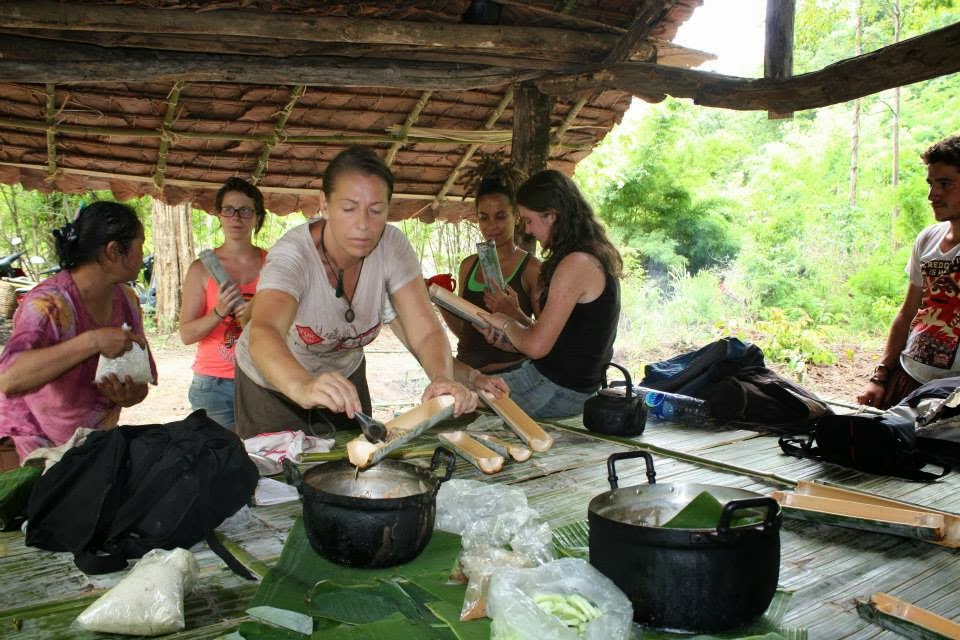
When it came time for lunch, the locals cooked rice and soup in large pots over an open fire. The meal was served in hollowed out segments of bamboo stalks with no utensils. It took some effort to overcome the filthy state of my hands and dig into the food with my fingers. It is relatively easy to eat sticky rice with your fingers, but it is difficult to eat soup with your fingers. I tried to have mostly
 |
| Eating traditionally prepared rice and soup in bamboo bowls |
rice in my bamboo bowl, but the nice older women who did the cooking wanted to fill my bowl with soup. It was challenging to eat, but it tasted fine and it was fun to have lunch with the local people the way they usually eat during their mid-day break. After we finished eating, we rested for a while longer, most of us taking naps, before heading back into the field. In the afternoon we planted soy beans on a steep slope that was very difficult to navigate. One of the locals even took a tumble - it was that hard to work there. We moved much slower on the cliffside and planted a significantly smaller area after lunch than before, but we all bonded more as we really needed to look out for each other on the dangerous slope. This day of hard work again demonstrated to me the simplicity of Thai food and rural life and allowed me to be part of the food production process. I really value this experience and would jump at the chance to do this type of work again if I have the opportunity to return to Thailand (If interested in volunteering, visit
Tacompai).
 |
Demonstration of what these spices (left to right: galangal,
chile, lemongrass, kaffir lime) look like when you should
and shouldn't eat them |
Another interesting experience was my second cooking class at the Time for Lime Cooking School (
timeforlime). This class was with my students and was in Koh Lanta, a long distance South from Chiang Mai, so was different from my first class in many ways. The food we prepared was slightly different than the recipes I had learned up North and I was in the position of teacher and chaperone so I could not completely relax and enjoy the class. I have to say, my high school students were very engaged and interested in cooking their own Thai dishes, but their enthusiasm only lasted through one course. At the opening of this course, the teacher gave an introduction to Thai food and explained some important ingredients, including fish sauce and curry paste. She also showed us common examples of the products that are exported to the U.S. that we might expect to find in our local Asian grocery store. I found this very helpful, but the best piece of information she gave us was a simple and perhaps obvious tip for eating Thai food: some ingredients are only meant to be eaten if they are chopped very small - if they are left in large chunks, they are there only for flavor and should not be eaten. As this was being explained, I wished someone had filled me in on this earlier, because I definitely had tried to gnaw on many large pieces of lemongrass and galangal. Apparently Thai people find it rather comical to watch foreigners trying to eat stalks of lemongrass. For anyone traveling to Thailand, heed this warning: trying to eat large pieces of these flavorful but tough plants is quite unpleasant!
 |
| Taste of Thailand in one bite |
Of the dishes that we prepared at Time For Lime, my favorite was a little appetizer described as "a taste of Thailand in one bite." To prepare this tiny dish, fold a wild pepper leaf to create a little cup, fill it with crushed peanuts, chopped chiles, diced red onion, diced ginger, and roasted coconut flakes. Squeeze some lime juice into the leaf cup, spoon in some honey, and eat it all in one bite! It is delicious and can be found in many Thai food markets. If you buy it at the market, it will look like a small kit with cups of ingredients and stacks of leaves. Knowing how to make this little snack allowed me to purchase the little kits and enjoy this cheap and tasty little meal throughout my trip!
Writing this post has made me so nostalgic for Thai food! Buying food at the markets or eating meals at inexpensive little cafes proved to me that healthy, fresh, simple foods can be available cheaply and readily. This really made me wonder why it is so impossible to have similar experiences in the U.S.. Why do all our food vendors need to be huge chains and why does our food have to come from so far away. The way we eat in the U.S. is destroying the health of our land and our people. I learned so much in Thailand, but the lessons in eating and preparing food really stand out. I have enjoyed trying to cook Thai foods at home and am happy to have been inspired to grow my own herbs, but I am really looking forward to returning to Thailand to learn even more about the food, culture, language, and ecosystems.


 The Monks were one of the most fascinating part of Thailand. They are so peaceful, calm, and beautiful in their saffron robes. I was obviously insanely curious about their lives, their meditation, their life after monkhood - but it is not easy to talk to Monks. For one, females are not even supposed to walk next to them on the sidewalk. Proper protocol is to step off the curb, so the Monk can pass you without getting too close. One of my favorite experiences was therefore the "Monk Chat." Wat Chedi Luang, one of the biggest in Chiang Mai offers a sit and chat from 1-6pm everyday. During this time, several monks sit out in an open area and you can sit down and ask any questions that you have about Buddhism or being a Monk. The Wat is the location of the Buddhism University, so there are Monks there that visiting from many different Wats around the country. The Monks are studying Buddhism, but are also working on their English. The chat lets them practice their English and allows tourists to gain a better understanding of the religion. The monk I chatted with was very open and outgoing and was eager to answer my questions. I asked what the different shades of orange robes signified and learned that the colors represent the Wats that the Monks come from. I mentioned that I had assumed that the colors were a type of ranking system, like the number of stripes on my husbands shoulder. The Monk smiled and explained that in Buddhism there is no ranking, no castes, everyone is equal and the same. I like this idea, but there is one glaring exception: women are not allowed to be monks. The Monk's answer to this was quite interesting, but I am not sure how widely believed it is: there once were many women monks, but before the temples were built, Monks lived in the forests. Women are not as fast or strong as men, so all the women Monks were eaten by tigers and snakes. Only women Monks can teach other women Monks, so the lack of women Monks precluded any women from becoming monks in the future. I was not totally convinced by this response, but I let it go. An important note is that women can become Monk in other countries; in Chinese Buddhism, for example, women are welcome to ordain.