Social Media

Showing posts with label thailand. Show all posts

Monday, August 25, 2014

Flying Solo

Recently one of my previous Broadreach students reminded me of something that I told     her a little over a year ago. She is off to explore Europe on her own for the next month and a half and has started up a blog to cover her solo adventures (http://gracefracher.com/). After reading about her trip, I was so excited for her and had to comment. 


I honestly had forgotten all about that conversation that I had with Grace and her friend, Analee, all those months ago, but as soon as she mentioned it the memories came flying back to me. I had been in Thailand for 10 days on my own scouting out future Broadreach programs and getting ready for my program. I spent time in Chiang Mai and Pai looking for sustainable organic farms and cultural experiences for future trips to participate in. I rode a mo-ped all over those two cities, sampled elephant riding, Thai cooking classes, bamboo rafting, hiking, tribal villages, permaculture centers, stayed on Khao San road in Bangkok, and visited the many majestic temples of Ayutthaya; I had been on planes, trains, and automobiles criss-crossing Northern and Central Thailand. To say the very least, I was on a travel high, and nearly breathless with the whirlwind of all those experiences in such quick succession. I gushed about about the benefits of traveling alone: meeting new people, taking risks, being more open, only worrying about yourself. I am beyond proud of Grace for taking the plunge and leaping out into the world alone. I decided it was time to share this insight with a wider audience. Get out there and travel alone!  

Growing up, my family and I did A LOT of Florida. And, I really mean a lot. It was great to get out of town and enjoy the warm contrast to New York winters, but Florida did not feel exotic or exciting. I had been to the same places in Florida so many times, it felt like being at home, just warm. When my father remarried, he went to Belize for his honey moon with his new wife. The stories and pictures that they returned with blew my mind. Throw in some Mary-Kate and Ashley Olsen travel movies and I was convinced it was beyond necessary to get out of the U.S. and see the world. 

In High School, I was desperate to go with my French class on the annual trip to France, but as fate would have it, September 11th brought the cancelation of all international school trips the year it was finally my turn to go. My next chance was Mexico, well kind of - it was Can Cun, for my senior trip. An impressively large group from my graduating class traveled together to Can Cun for gradweek 2003: 7 days of binge drinking and debauchery. This trip should in no way qualify as international travel. But, in my string of irresponsible choices, I hopped off a stage to the dance floor below while barefoot and sliced my foot open on a piece of broken glass. In order to deter infection, a friend and I ventured off the strip on a public bus into Mexico, to a Wal-Mart of all places, for some first aid supplies. The experience was eye-opening - Mexico was a lot more than clubs and all inclusive resorts. Traveling abroad meant a lot more than white sand beaches, aqua waters, and frozen drinks. I wanted to see more, to know more, to really understand how different life was in other places. 

When I started University, I knew very little about what the next 4 years had in store for me, but I knew I would be studying abroad. The summer following my freshman year was filled with University Physics 1 & 2 so I would not fall behind on my core classes while I spent a semester in Australia Sophomore year. I convinced my best friend to sign up with me, and we were on a airplane to Brisbane in January 2005. I was so lucky to have Bridget as a traveling companion. She is patient, and fun, and up for anything. Having a friend gave me someone to live with, someone to commute with, someone to go to the beach with, someone to study with, and someone to party with. It was excellent, and except for the normal girlfriend drama when you are 19, it was pretty easy. My travel bug bite flared up again during my senior year, and Bridget and I signed up for a January intersession course in mainland Ecuador and the Galapagos Islands. This trip involved a group of about 20 students from our University, and Bridge and I did make some new friends, but  again I always had a roommate, someone to sit next to on the bus, someone to take photographs with, someone to put sunscreen on my back when I decided to wear it. 


After graduating, I decided I knew what I wanted out of a trip and I was ready to plan a trip alone (well, mostly). I arranged to volunteer at a marine science center in Plettenberg Bay, South Africa for 6 weeks, and I would spend 6 more weeks backpacking the coast from Plett to Jo'burg afterwards. On the way home, I would meet Bridget in London and we would have 10 days to spend in London, Paris, and Amsterdam together. When I got off the plane in Cape Town and made my way to my first backpackers' hostel, it sunk in that I would not have a roommate, nor would I have someone to cook dinner with. The following days would include sightseeing on my own. I may have panicked a little and I definitely felt pretty alone that first night. The next morning at breakfast, I met the hostel owner's daughter. She was a university student in Florida and was visiting her mother with her American boyfriend for the January break. She was very outgoing and invited me to spend the day hiking with her and her boyfriend. I jumped at the chance and got to visit local hiking spots that were not congested with tourists. Would I have done that if I was with my best friend from home? Instincts say no.


Throughout my time in South Africa, I continued to have experiences like this. South Africa is extremely amenable to backpackers and one of the best amenities is the Baz Bus. This bus provides a hop on, hop off service, from door to door of backpacker establishments along the coast and inland. One buys a pass for a period of time, rather than a particular route or distance, and you can travel as much and as far as you wish during that time. On my first Baz Bus ride, a talkative, friendly guy with lots of dreadlocks sat down next to me. He was a South African that worked at a backpackers North from where we were and he was meeting some friends further south. He spent the whole ride telling me all about places I needed to see and insisted that I visit the place where he worked when I passed through. A couple weeks later, I found myself at Tube n' Axe hanging out with my friend from the bus and his friends. I spent 5 days there, jumped the worlds highest commercial bungee jump, went on several jungle hikes, hiked the coast, cliff jumped into the Storms river, and spent evenings drinking with locals in the bar. Another time, I was in a town called Wilderness and met another single female traveler named Maile. We walked along some abandoned railroad tracks on the coast together, enjoyed the views, conversation, and meeting artistic and creepy squatters in an abandoned restaurant built inside a huge cave. Later in my trip, I was walking along the side of a road and Maile drove by, honked her horn and told me to jump in. We had a long lunch together and she did a tarot card reading for me. Years later, I have visited her in California twice and will hopefully be visiting her in Hawaii in the near future. 

The moral of the story is that when you have your bestie, or a family member, or a school group, you have a safety net. You have people who have little choice whether or not they talk to you or spend time with you and vice versa. When you make plans or change plans, you must consult with your tripmates and come to a consensus. Traveling alone gives you the freedom to talk to whoever happens to sit down next to you and to change your plans on a whim. If a person on the bus suggests that you get off at the next stop because he heard a rumor that there is a great waterfall - you are free to jump right off. In addition to the freedom to be spontaneous, you are also free from judgement. You are not traveling with any figurative baggage from home - you do whatever you want and only those you tell will know about it. You do not need to worry if your tripmates are having fun, if they think the trip is as meaningful as you do, if they are secretly counting the hours until they are on a flight home. Traveling alone may me the a selfish choice to make, but I swear it is the best choice you can make. Traveling alone allows you to have the lofty experiences you dream about when you decide you want to travel. 

I realize that for many safety seems like it would be an issue. I promise you, travelers look out for travelers. Foreign countries are not more dangerous than your own, they are just foreign. As humans we have a tendency to fear what is not familiar. But really, when has something been fun and not been at least a little scary in some way? Safety is absolutely not a worthy excuse. Go ahead, fly solo. You will not regret it. 


Wednesday, June 18, 2014

Memories of Thailand

It is the time of year again when I start preparing for another an adventure of a lifetime. This is now my fourth year teaching summer study abroad courses for Broadreach and every year has brought new challenges, opportunities for growth, exploration, and inspiration. As I get ready to set off with a new group of students to a new and exotic corner of the world, I can't help but reflect on my experiences from last summer. Last summer's Thailand trip was really special in many different ways for me. The trip started with an opportunity to do some scouting for future programs and explore in the northern part of the country. I then went back to Bangkok and took a very slow public train to Ayutthaya to check on the accommodations and activities for my group there. In Ayutthaya, I went on a private boat tour of the major Wats and learned a lot about the history of Thailand. Back in Bangkok, I met my students and set out on an epic experience with some great kids. The program brought us in contact with many interesting people and places and I am quite sure we all learned a fair bit about fish, Thailand, and ourselves. After my students set off for the US, I met up with one of my favorite girls on the planet and I got to see yet another part of the country. Before traveling in Thailand, I had never stepped foot on the Asian Continent. After crisscrossing the country over the course of the summer, I was completely enamored with the country, culture, food, and people.

Since Thailand was my only experience in Asia, I somehow imagined that all Asian countries would be similar in someways. I know that this is absolutely ridiculous, as Asian cultures are extremely varied and diverse, but a little part of my brain expected life in Japan to be similar to life in Thailand. Now that I have lived in Japan for 2 months, I still catch myself comparing it to Thailand all the time, when really Thailand and Japan are as different as Japan and the U.S. Although the comparisons are not warranted, my new home has kept Thailand on my mind all the time. It probably does not help that I have been reading Thai detective novels and some very poignant short stories about life in Thailand. It probably also does not help that I was quite set on teaching in Thailand again this summer, but the Thailand programs were cancelled due to the political unrest.


Since I absolutely cannot get Thailand off my mind, I thought I would revisit my travel journal and share some of my memories. I think the major reason that Thailand has stuck with me in a way unlike any of my other travel destinations is the mystical feeling that pervades everything in the country. In exploring Chiang Mai, my first destination last summer, I was overwhelmed by the abundance temples, or Wats, that seemed to be present on the corner of every intersection. The Wats are like compounds with a main temple, dorms, teaching spaces, and administration buildings all walled in by a high, solid wall and gates that are closed at night.  The variation in style of the Wats is as impressive as their number. Some of the temples are gilded in gold and are so shiny and luminous it is almost painful to look at them in the summer Thailand sun, while others are humble straw thatched buildings, and some are huge stone ruins that were literally built ages ago. Bustling among the buildings and statues of the Wats are men and boys of all ages dressed in flowing, deep orange robes. The monks live at the temples with no possessions. Every morning, they go out into the streets with giant bowls and collect food from whoever is willing to donate. They live completely at the mercy of the people of the community, who also donate the money that is used to build and maintain the Wats. This charitable system works because of the intense superstitious nature of the Thai people; they donate to the Wat whenever they are in need of some good luck.

The Monks were one of the most fascinating part of Thailand. They are so peaceful, calm, and beautiful in their saffron robes. I was obviously insanely curious about their lives, their meditation, their life after monkhood - but it is not easy to talk to Monks. For one, females are not even supposed to walk next to them on the sidewalk. Proper protocol is to step off the curb, so the Monk can pass you without getting too close. One of my favorite experiences was therefore the "Monk Chat." Wat Chedi Luang, one of the biggest in Chiang Mai offers a sit and chat from 1-6pm everyday. During this time, several monks sit out in an open area and you can sit down and ask any questions that you have about Buddhism or being a Monk. The Wat is the location of the Buddhism University, so there are Monks there that visiting from many different Wats around the country. The Monks are studying Buddhism, but are also working on their English. The chat lets them practice their English and allows tourists to gain a better understanding of the religion. The monk I chatted with was very open and outgoing and was eager to answer my questions. I asked what the different shades of orange robes signified and learned that the colors represent the Wats that the Monks come from. I mentioned that I had assumed that the colors were a type of ranking system, like the number of stripes on my husbands shoulder. The Monk smiled and explained that in Buddhism there is no ranking, no castes, everyone is equal and the same. I like this idea, but there is one glaring exception: women are not allowed to be monks. The Monk's answer to this was quite interesting, but I am not sure how widely believed it is: there once were many women monks, but before the temples were built, Monks lived in the forests. Women are not as fast or strong as men, so all the women Monks were eaten by tigers and snakes. Only women Monks can teach other women Monks, so the lack of women Monks precluded any women from becoming monks in the future. I was not totally convinced by this response, but I let it go. An important note is that women can become Monk in other countries; in Chinese Buddhism, for example, women are welcome to ordain.

Fat Buddha
Another great story that the Monk relayed to me had to do with Buddha's appearance. When visiting all the Wats, I saw statues of Buddha in many different positions and I also saw fat Buddhas and skinny Buddhas. I learned that the different positions represented the different meditation positions and that there are prescribed meditation positions for all sorts of things - your birth day of the week (M,T,W,Th, F, S, Sun) is one of the most prominent. The fat and skinny Buddhas came with a rather comical tale. The skinny Buddha was a very, very handsome man, but, in order to be happy and live a pure life, he practiced celibacy. His pleasing appearance impressed the ladies and women were constantly trying to seduce him. In order to remove the temptation and live more peacefully, Buddha ate gluttonously and purposely reached obesity to keep the women at bay. This story might be slightly sexist as well, but it did make me laugh.

Skinny Buddhas in a walking meditation room at a Wat in
Ayutthaya
The superstitions of the Thai people go beyond donating food and supplies to the Buddhist monks and temples. While driving though Thailand, it is impossible to miss the vendors at every single traffic light that weave between the stopped cars to sell beautiful flowers strung together to be hung on rearview windows. When I first saw these vendors, I expected they would be ignored just like the people who walk between cars in NYC and try to wash windshields for a couple dollars. The vendors selling the flowers, however, were definitely not ignored. Practically every time I was in a car, whether taxi or airport transfer van or personal vehicle, the driver reached out the window with some money and then hung the flower garland over their rearview window. Apparently, these garlands grant drivers the necessary luck to survive driving in Thailand. And, driving in Thailand is no joke. While glancing through my journal from last summer, I stumbled upon this quote: "The most overwhelming thing, however, is crossing the road. Drivers do not yield to pedestrians and do not stop at crosswalks. There are no signs to "walk" or "don't walk." One day of walking has told me that I do not want to drive here." I did eventually drive, a motorbike at least, but I never did purchase a flower garland for luck.

Honestly, I could go on and on about Thailand forever. And I will more in the future. As much as I wish I was going back to land of smiles this summer, I am getting really excited about Fiji and teaching a course all about sharks. I am sure Fiji will be magical in its own way, It is just hard to imagine anywhere being as magical as Thailand.

Wednesday, November 13, 2013

Eating and Cooking in Thailand

This past summer, I was extremely lucky to have the opportunity to travel to Thailand and teach a session of college level fish biology for a group of American high school students. Together, we trekked throughout the country from Bangkok to Koh Tao, Khao Sok, Koh Lanta, and Ayutthaya. I also had some time off to see the country without a group of teenagers trailing behind me and visited Chiang Mai, Pai, and Koh Chang. Throughout the course of the summer, I learned about a new marine ecosystem, a new country and culture, and a fair bit about myself. I rode elephants, went scuba diving, taught amazing students, participated in organic farming, and made new friends. But, of all these new and exciting experiences, the food (eating and cooking) may have been the most valuable and enduring.

Before going to Thailand, I loved Asian food and enjoyed eating at Thai restaurants in particular - I was really looking forward to having Thai food day in and day out, all summer long. I especially appreciate Thai food for the curries with coconut milk instead of cow's milk. Curries are undoubtedly my favorite meal to consume, but when eating out at Indian restaurants, I always worry about cream and ghee. At Thai food restaurants, I do consider how much chicken stock I am ingesting in "vegetarian" dishes, but at least I know I am safe from dairy. I love all the vegetables and spices and the light fluffy rice noodles that do not bog down my belly with gluten. As I prepared for the summer, I read two versions of Lonely Planet and perused many blogs and websites. In my reading, I kept coming across curious proclamations about great "western food" joints for when you are sick to death of Thai food. I thought this was absurd! How could anyone become sick of Thai food? I did not think that this would happen to me, but I conceded that I would not know until I had actually spent sometime in Thailand.

It turns out that the notion of becoming sick of Thai food really is absurd. After being in the country for almost 2 months, I was more obsessed with Thai food than ever. As the end of my trip approached, I dreaded returning to the U.S. for fear of missing many things about Thailand, but the food was at the top of the list. While in Thailand, I both sought out and stumbled upon experiences that deepened my appreciation for Thai culinary culture. The most prominent, I am sure, is the first cooking class I participated in at the Thai Farm Cooking School (ThaiFarmCooking.net), just outside of Chang Mai. I participated in this class on one of my very first days in Thailand and it ended up improving my whole trip; throughout the rest of my trip, I was able to distinguish flavors and ingredients and had a better understanding of food culture and customs. A second cooking class, eating meals with locals, and visiting several food markets continued to expand my interest in and passion for Thai food throughout the summer.

Pern Teaching our group about different types of rice
That influential first cooking class started with a tour of a small local food market in Chiang Mai. Our teacher for the day, Pern (pronounced as a punctuated Pon), paraded us down the aisles of the market, stopping whenever anything caught her eye. She showed us different types of rice and explained the variation in texture, use, and preparation. I can remember learning about white rice, old rice, and sticky rice, but there were several more varieties that escape my memory. Old rice is yellowish in color and has aged for up to a year; this type of rice is used to create rice noodles and rice wrappers for spring rolls. Sticky rice and regular rice are harder to tell apart just by looking looking at them, but they are prepared very differently and easier to tell apart after they are cooked. For Regular rice, you simply rinse it, put in a rice cooker with water, and press "cook." Sticky rice must be soaked for 24 hours and is then steamed in a straw basket. We also learned about palm sugar and the different forms in which you could purchase it; there was liquid, syrup, crystals, and solid blocks. Palm sugar comes from palm trees on large palm plantations and is boiled down to varying densities and concentrations that are used for different purposes. Initially, I thought palm sugar would be just another sweetener, but it is not; it is has a sweet, savory flavor that has hints of vanilla, but cannot really be described with words, at least not by me. But, I did find myself ordering "palm juice" - basically sugar water - at the markets on several occasions.

Pig Head at food market. Spinning plastic bags for
fly prevention can be seen in the background.
After walking around with Pern and learning about different ingredients, she released us to explore on our own for a bit before we headed to the farm for the actual cooking class. To say that the market was diverse and colorful is something of an understatement. There were fruits that I had never seen before piled up high in beautiful arrangements and there were animals I was familiar with, but had not seen displayed in such a way before. Every part of the animals was used: there were hearts, stomaches, feet, tongues, kidneys, livers, intestines, and heads on display for purchase. None of this meat was refrigerated or covered, but there were plastic bags attached to fans being spun above the food products to keep flies away. I also saw tanks full of fish and buckets full of blood cockles, a mollusk that is dredged from the Andaman sea, which surprised me since we were rather far from the sea. I think the animal product that most alarmed me was a large bowl full of frogs covered with a red plastic net. These large frogs looked terrified and their faces were bloodied from jumping up against the walls of their container. As appetizing as the fruits were, the animal products were equally unappetizing, but I appreciated the realness of it. These animal parts were not wrapped in plastic, pretending they were not parts of animals that used to be alive. Buying these animal products meant understanding and appreciating where they came from - a far cry from supermarkets in U.S.

Organs at Chiang Mai Food Market
Blood cockles at Chiang Mai food market.
Dredging for these shellfish is extremely
harmful to near coastal ecosystems.
Dragon Fruit at Chiang Mai Food Market


Once at the farm, the lesson started with a tour of the garden. Throughout this tour, I was able to see how the different ingredients grew and what they looked like before they were cooked and ground into pastes. Eating the mini chiles straight from the plant was actually very intense, even though the spiciness they impart on a dish when cooked is usually quite mild. Perhaps the most interesting plant in the garden was the loofah plant. I had no idea that these skin polishing products, available at every wal-mart across the world, actually grew on tropical plants. I just never really thought about it, which I believe is common for most Americans - we buy things without stopping to consider where they come from or how they are produced. A close second was the different varieties of eggplant. There are Thai eggplants that are not much larger than peas! Another popular Thai eggplant is the size and color of a tennis ball. Previously, it had not occurred to me that the fat purple eggplants I know, are not the eggplants everyone knows. Now if only I could find these treasures in my local super market...

Following our garden tour, the class got down to business and started pounding out our own curry
Enjoying the open air kitchen and the simplicity of Thai cooking.
paste. We had the choice to make red, yellow, or green curry and I chose green curry. Green curry uses more fresh, rather that dry ingredients, so the paste is a lot mushier. To create the paste, I sliced 2 long green chiles, chopped a shallot, a small piece of galangal, kaffir lime rind, garlic, lemongrass, and Thai ginseng. I added all these ingredients, along with roasted cumin and coriander seeds and some salt to a huge stone mortar and pestle, and got to work. The grinding takes time and a fair bit of effort, but is not too taxing. Thai women have spice grinding down to a science, but what I found to be key is to not be shy and to really bash the spices. My curry paste turned out very fine and was validated by Pern with an approving smile, but others in the class were not able to get their curry paste to be quite a paste, per se. Pern told us that it was fine if our paste was coarse, as long as we liked it that way, but that Thai people prefer a very fine curry paste.

Once the paste was finished, we set it to the side and prepared some delicious Tom Yam Soup. An
Pad Thai from the restaurant associated
with the Chiang Mai Women's Prison.
important lesson in the preparation of this dish was the 4 major Thai flavors: Salty, Sweet, Sour, and Spicy. Different people enjoy these flavors in different proportions so food is actually usually prepared rather bland and these four flavors are provided on the side in the form of chile powder, salt, sugar, and lemons or limes, so the eater can add them as needed. Each of these flavors was incorporated into the Tom Yam Soup and since we were preparing single portions, we could add them in whatever proportion we preferred - I added quite a few chile peppers. After eating the soup, I was full and satisfied, but we went on to finish preparing the curry, steamed spring rolls, and made traditional Thai Papaya salad. After eating all this, we also made dessert. Most of my classmates chose to make mango and sticky rice since this is the most popular Thai dessert, and it is delicious, but I decided to try something new and opted for bananas boiled in coconut milk. This turned out to be a good choice. The dessert is so simple, it is almost humorous. To prepare the dish, simply boil bananas in coconut milk and add palm sugar to taste. Simple, but perfect, and a new favorite. I ordered this dish every chance I got while in Thailand  and have even made it at home, although the bananas here really are sub-par.

The simplicity of my new favorite dessert is a common theme in Thai cooking. I was surprised by how simple all the dishes prepared during the class truly were. The secret to Thai cooking is not complicated recipes and expensive ingredients or a fancy kitchen, it is super fresh, healthy, simple ingredients. It is no wonder that Thailand is considered the country of smiles! I was happy to learn this secret, but sad, too, because it meant that the food I was eating in Thailand really could not be completely recreated in my kitchen. But, I knew I would try!

Sowing soy beans outside of Pai
Throughout the rest of the summer, I had many more formative experiences relating to Thai food, cooking, and eating. When I travelled North to Pai, I had the opportunity to volunteer my time assisting local farmers in planting several soy bean fields. Soy is an important crop in Thailand; it is eaten as sprouts, tofu, milk, and beans and is exported both whole and as prepared foods. A group of other young travelers and I rode out away from Pai, past a small village, and onto a very rugged dirt road that eventually faded into a foot path. None of us spoke Thai, and none of the village people spoke English. We communicated mostly by the village people demonstrating what to do, and then we tried to copy them. If we did it right, we received smiles, if we did it wrong, we were corrected. We worked side by side all day planting soybeans in rugged, rocky, uneven terrain.

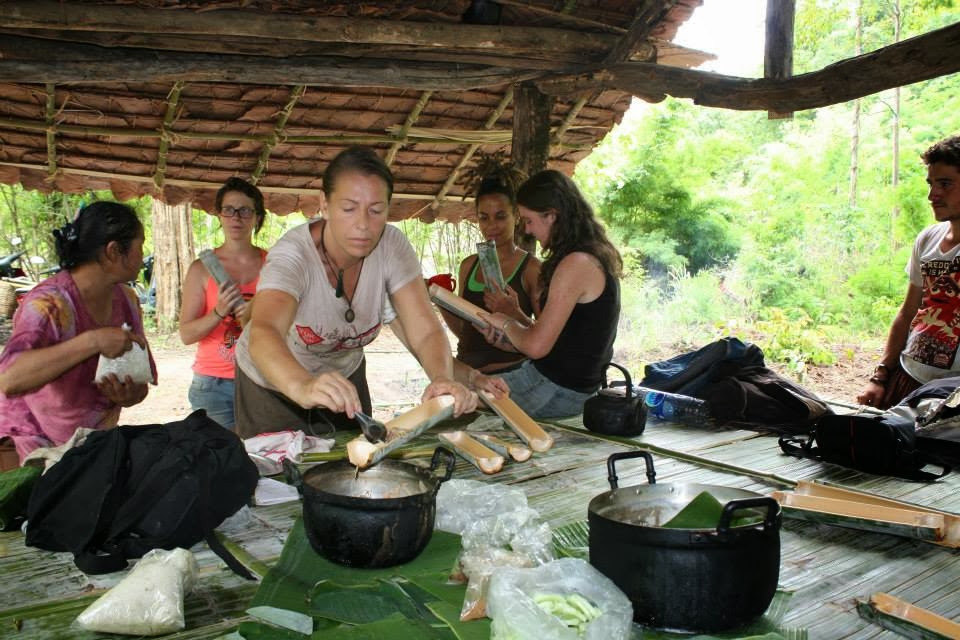
When it came time for lunch, the locals cooked rice and soup in large pots over an open fire. The meal was served in hollowed out segments of bamboo stalks with no utensils. It took some effort to overcome the filthy state of my hands and dig into the food with my fingers. It is relatively easy to eat sticky rice with your fingers, but it is difficult to eat soup with your fingers. I tried to have mostly
Eating traditionally prepared rice and soup in bamboo bowls
rice in my bamboo bowl, but the nice older women who did the cooking wanted to fill my bowl with soup. It was challenging to eat, but it tasted fine and it was fun to have lunch with the local people the way they usually eat during their mid-day break. After we finished eating, we rested for a while longer, most of us taking naps, before heading back into the field. In the afternoon we planted soy beans on a steep slope that was very difficult to navigate. One of the locals even took a tumble - it was that hard to work there. We moved much slower on the cliffside and planted a significantly smaller area after lunch than before, but we all bonded more as we really needed to look out for each other on the dangerous slope. This day of hard work again demonstrated to me the simplicity of Thai food and rural life and allowed me to be part of the food production process. I really value this experience and would jump at the chance to do this type of work again if I have the opportunity to return to Thailand  (If interested in volunteering, visit Tacompai).

Demonstration of what these spices (left to right: galangal,
chile, lemongrass, kaffir lime) look like when you should
and shouldn't eat them
Another interesting experience was my second cooking class at the Time for Lime Cooking School (timeforlime). This class was with my students and was in Koh Lanta, a long distance South from Chiang Mai, so was different from my first class in many ways. The food we prepared was slightly different than the recipes I had learned up North and I was in the position of teacher and chaperone so I could not completely relax and enjoy the class. I have to say, my high school students were very engaged and interested in cooking their own Thai dishes, but their enthusiasm only lasted through one course. At the opening of this course, the teacher gave an introduction to Thai food and explained some important ingredients, including fish sauce and curry paste. She also showed us common examples of the products that are exported to the U.S. that we might expect to find in our local Asian grocery store. I found this very helpful, but the best piece of information she gave us was a simple and perhaps obvious tip for eating Thai food: some ingredients are only meant to be eaten if they are chopped very small - if they are left in large chunks, they are there only for flavor and should not be eaten. As this was being explained, I wished someone had filled me in on this earlier, because I definitely had tried to gnaw on many large pieces of lemongrass and galangal. Apparently Thai people find it rather comical to watch foreigners trying to eat stalks of lemongrass. For anyone traveling to Thailand, heed this warning: trying to eat large pieces of these flavorful but tough plants is quite unpleasant!

Taste of Thailand in one bite
Of the dishes that we prepared at Time For Lime, my favorite was a little appetizer described as "a taste of Thailand in one bite." To prepare this tiny dish, fold a wild pepper leaf to create a little cup, fill it with crushed peanuts, chopped chiles, diced red onion, diced ginger, and roasted coconut flakes. Squeeze some lime juice into the leaf cup, spoon in some honey, and eat it all in one bite! It is delicious and can be found in many Thai food markets. If you buy it at the market, it will look like a small kit with cups of ingredients and stacks of leaves. Knowing how to make this little snack allowed me to purchase the little kits and enjoy this cheap and tasty little meal throughout my trip!

Writing this post has made me so nostalgic for Thai food! Buying food at the markets or eating meals at inexpensive little cafes proved to me that healthy, fresh, simple foods can be available cheaply and readily. This really made me wonder why it is so impossible to have similar experiences in the U.S.. Why do all our food vendors need to be huge chains and why does our food have to come from so far away. The way we eat in the U.S. is destroying the health of our land and our people. I learned so much in Thailand, but the lessons in eating and preparing food really stand out. I have enjoyed trying to cook Thai foods at home and am happy to have been inspired to grow my own herbs, but I am really looking forward to returning to Thailand to learn even more about the food, culture, language, and ecosystems. 

Tuesday, June 25, 2013

Captive


 While staying in Chang Mai, I encountered beautiful, intelligent beings living in captivity in two separate and very different circumstances. The first was at the Chang Mai Women's prison and the second was at an elephant riding attraction. It may not be completely correct to compare humans and elephants living in captivity, but the two experiences evoked similar emotions and stimulated significant consideration and contemplation.

I visited the women's prison on my first day in Chang Mai, and really my first true day in Thailand. I was still adjusting to the climate and was fairly jet lagged, so I was exploring the city in a bit of a fog. I read in Lonely Planet that the prison has a progressive vocational training program that aids in the transition from prison to freedom. Before release, inmates are taught Thai massage from a prestigious local school along with other handicraft skills. The women then perform massages for tourists and sell their crafts at a very pleasant facility across the street from the prison. They receive a portion of the proceeds, which they can save so they are not completely broke upon their release.

When I arrived at the massage and craft center, I walked through a garden to a reception area and made a massage reservation with the female prison guard at the front desk. There was a two hour wait for a massage, so I sat at a table in the garden and ordered lunch. Pad Thai and a coconut smoothie were delivered promptly and as I sat enjoying my lunch, I also enjoyed the many native plants and sculptures that adorned the garden. The ground was covered in decorative brick work and above me was a thick canopy of green trees with orchids growing on their trunks. This setting surely did not feel like a prison. The only reminders that I was on the property of a prison were signs with pretty script spelling out "Prison Products," where there were soaps, change purses, and small dolls on display for sale, and of course the prison guards.

I was impressed even further when my number for a massage came up. I left my shoes outside and slipped on complimentary slippers. Once I was shoeless, I was led inside by the guard and given a set of scrubs to change in to in the bathroom. This was fairly comical because I was given size XXXL bottoms, but I tied them on tight and was led to a sitting area to wait to have my feet washed. The prison guard went back to attend to another guest outside and I was now in the care of the prisoners.

All of the prisoners were young and pretty with kind eyes and loads of patience. The first girl I interacted with simply washed my feet and did a pretty good job disguising her disapproval of the state of my feet and legs (walking around a city in flip flops is messy!); I was a little embarrassed, however. I sat back down in the waiting area for hardly a moment when a girl with a warm childlike face asked if my feet had been washed already and then led me to her massage table. When I laid down, she looked at my feet and asked again if my feet had been washed. Apparently, they still didn't look clean. After skeptically accepting that this was as clean as my feet would get, she began her massage.

As I looked around the room, I noticed that the sequence of the massage was the same on each table but that each girl had a personal style. My masseuse was not rough, perhaps overly gentle, and as the massage proceeded, she would catch my eye and smile shyly. As I lay there enjoying being stretched and pulled, popped and prodded, I could only think about what crime my masseuse could possibly have committed. I was too shy to ask, so I will never know, but she seemed too gentle and kind to have done anything very punishable. 

I left feeling happy and warm and the feeling lingered as I walked through the evening streets watching the day's business wind down. The post massage glow did not fade until much later: probably after stuffing myself sick at the vegetarian buffet at my guest house. And as it did, I began to wonder if I felt like I had taken advantage of the girls at the prison massage parlor or if I had paid them a service by visiting the facility. Months later, I still don't know. I don't know exactly what was the girls' cut of the minuscule fee I paid. And, how many hours did they work? How many days a week? Did they enjoy it? Did it feel like slavery to them? Being too timid to ask, I won't know. But, I can imagine how I would feel in their circumstances. 

Two days later, I visited an elephant camp on a full day tour I had booked through a tour company a block from my guesthouse. The elephant riding was the first activity of the day and I was a little apprehensive about what I might witness. These poor beings had just as little say in performing their services as the women prisoners. Elephants in Thailand are revered, but currently are in a bad spot. They had been in high demand during the height of the logging boom. But as the number of trees dwindled, the king proclaimed a moratorium on logging in Thailand and the elephants found themselves unemployed. Eating several tons of food does not make an animal a likely or welcome pet, so the elephants soon found themselves homeless, as well. Tourism in Thailand is the only thing that supplies enough income to support elephants these days, and many elephant camps that give tourists elephant rides and the opportunity to care for elephants have sprung up throughout the country. The camps have varying reputations, with some taking very good care of the animals and others being rather cruel. 

The camp I visited this day fell somewhere in the middle, but closer the humane side than the cruel. The mahouts, the men that trained the elephants, seemed well connected with the animals and were skilled in directing them. The mahout that led the elephant I rode invited me out of the tourist seat and instructed me to sit on the elephants neck. He failed to give me any further instructions, however, so I had a bumpy ride (I later learned that it is important to sit as close to the head as possible to have a stable ride). As we rode along a quaint forest trail, I fed the elephant a banana each time he reached his trunk back to me. Occasionally we would stop at little shops on stilts so that I could purchase another bunch of bananas for 20 Baht (less than a dollar), and we would be on our way - walking along the trail with me hanging on for dear life, the elephant munching bunches of bananas and easefully ambling forward, the mahout snapping pictures from the ground as he walked beside us and occasionally giving the elephant an order.

Most of the ride was very pleasant, only once was I forced to consider the well being of the elephants. The elephants wear chains around their ankles that attach them to trees or buildings. Someone later told me that the elephants are fully able to break their chains whenever they wish, but that they stay because they are satisfied; they have food and water and are cleaned up after and given daily exercise.  That seems reasonable, but after noticing an elephant chained to a tree quietly swaying back and forth with a bored, crazed look in its eyes, I had to wonder if the elephants were happy and fulfilled. They are so smart and soulful, surely walking in large circles and begging for bananas all day cannot be enough. 

It occurred to me that as I enjoyed a massage and a delightful ride through the forest, the humans and elephants involved were enduring indignity and simply smiling and performing a service because they had no other choice. Would I do it again? Would I go back to these places and have another $7 massage from a prisoner or $10 elephant ride? I can't say. But, I would encourage others to visit and come up with their own conclusions. 

                                          
                              The elephant that carried me through the woods.
                                 Another captive elephant walking up to meet its next rider.
The mahout who has trained and cared for the elephant I rode.
Another mahout with his elephant.