As the online learning phenomenon has been taking over the educational system in the U.S. during the last decade, I had managed to remain mostly indifferent to the movement. I didn't think that I would ever want to take an online class, and I doubted that you can achieve the same level of education through an online course as through a classroom course, but I was not vehemently opposed to the movement. That was until many of my middle school students started choosing online high schools instead of the real thing. At that point, I began to feel a little angry; I was beginning to understand that all these online schooling options might really be about making money rather than what is best for the student, as online high schools are now getting state funding put aside for charter schools. Online classes can be great for adults with full time jobs trying to achieve a master's degree, but an online bachelor's is questionable, and high school online sounds like it would be downright detrimental to the student. School is about so much more than just memorizing content, writing a paper, and taking a test. School is about interacting with your peers and your teachers, discussing topics, going deeper, and learning from each other. And on the non academic front, school is about meeting people that are different from you, learning about other cultures, and trying out sports and clubs and extracurricular activities. The idea of high school consisting of a couple hours at your computer each day seems so sad to me.
I strongly encouraged my middle school students to talk with their parents and try to find an actual school that they could attend. I was mostly unsuccessful, though, and many of my students went on to stay home and complete coursework online. These students would come back and visit and gloat about the fact that they didn't have to go to school, and my heart would break for them. I continued to speak out against online high school, but I realized that having never taken an online class, I was at a disadvantage in my arguments. I know all the benefits of traditional schooling, having attended a traditional high school, college, and graduate school, but every single class I have taken has been in a classroom with other students and a real, live teacher. So, when the opportunity presented itself, I enrolled in an online class. The American Meteorological Society (AMS) hosts online graduate courses in climate and ocean science for teachers. The goal is to better educate teachers in the sciences so that they are better able to share information with students and other teachers at their school. Any educator can participate in these pass/fail courses and receive 3 graduate credit hours from the State University of New York at Brockport. My degree is in marine and atmospheric science, but really I haven't taken a single atmospheric course; this opportunity would allow me to strengthen my anti-online learning standpoint (I swear I entered this experiment with an unbiased mind), and bolster my atmospheric knowledge at the same time.
My AMS course started in September with a "gomeeting" with the course instructors and the students. The technology worked fairly well, and I was able to have all my questions answered regarding assignments and sign-ins for information access. There would be two more of these online meetings in the middle and at the end of the semester. Aside from the meetings, there were weekly assignments that were submitted to two mentors by email, who responded with corrections and feedback. The assignments were fairly simple and straight forward. I read one chapter per week from the course text book and there were review questions that went along with the reading. The questions were really just to prove that you had read the assigned pages, however, as they were simple multiple choice questions. The most interesting assignment were the "investigations." These consisted of visiting specific websites to access data sets from different governmental agencies and then answering simple questions about the data. The questions were never difficult, but this did expose me to new sources of information that I do hope to use in the future. Lastly, there was a "current climate studies" assignment that required linking to recent governmental climate publications, finding specific information in the publication, and again answering easy multiple choice questions. At the end of the course we were also required to informally propose a project that would make use of what we had learned in the course.
I feel that the AMS course had a lot of potential; I did complete all assignments and enjoyed most of them, but I do not feel I know much more about atmospheric science now than I did before the course. I think this is because of several factors, but mostly because of the lack of lecture. I am a person that can read from a textbook and teach myself material well enough to pass tests and write papers, but the information does not stick long term unless someone makes it interesting in a personal way. Having a professor relay personal stories and experiences turns academic material into an entertaining experience that lends itself to being stored in my brain into the furture. Reading a textbook just does not have this effect on me. Also, the type of questions in the course did not stimulate thought and critical thinking, they were solely a tool for the instructors to know whether or not the reading had been done, not how thoroughly I had understood what I had read. The email feedback was helpful, and whenever I had a question, my mentor was willing to spend time answering it, but again email is just so impersonal. At the end of it, I did not feel like I had learned at a graduate level and I was left even more disillusioned with the idea of online learning.
In an ironic twist, I am now teaching a "blended" online and classroom course in marine biology at the local community college. I went into this teaching experience extremely optimistic about what I would accomplish during lecture and the types of deep, stimulating conversations that would take place on the message boards regarding conservation issues and policy. My optimism was quickly dissolved and replaced with realism. The course is a five credit course with three credits being considered classroom and two credits being considered online learning. This means that students are meant to do a significant amount of independent learning and complete weekly online assignments. I assigned videos available on PBS.org about ocean conservation in conjunction with several related current events articles each week and wrote a detailed prompt to initiate a hearty discussion on the message board. I clearly detailed what was expected in their initial responses to the videos and news articles and required that they respond to at least 2 other students' responses agreeing or disagreeing with their viewpoint and defending their position. The response to these assignments was a lot of grumbling, complaining, low participation, and pathetic effort. My hopes and dreams of a robust conversation pertaining to relevant, current issues were dashed. I think I can fairly say that the online portion of the class I am teaching has been a fail.
As I interact with more and more young people, I have noticed that many of my students are great in class, but really don't want to put in much time outside of class. They love technology, but really enjoy using technology for fun, fleeting endeavors, not prolonged or challenging efforts. Technology has made life much more convenient, everything is available with a finger swipe, but actually spending time to read a whole article is not convenient and does not hold their attention. Doing homework, reading, writing, and having academic conversations through technology seems to be the antithesis of how students expect to use their devices. I don't think that it is impossible to have a quality online learning program, but I don't think that online is the right platform for high school and I really believe that undergraduate and graduate students are missing out and getting a lower quality of education when they take online classes instead of traditional courses. I am nervous that the online learning movement will continue to push forward and the next generation is going to be even lazier and less knowledgeable than the current one.
What have your online experiences been like? What do you think the world would be like without actual schools? I am curious if others have had better experiences and have different points of view.

Musings, teachings, lessons, and experiences from a marine scientist, teacher, yogi, military wife, and marathoner
Social Media


Monday, February 24, 2014


Wednesday, November 13, 2013
Eating and Cooking in Thailand
This past summer, I was extremely lucky to have the opportunity to travel to Thailand and teach a session of college level fish biology for a group of American high school students. Together, we trekked throughout the country from Bangkok to Koh Tao, Khao Sok, Koh Lanta, and Ayutthaya. I also had some time off to see the country without a group of teenagers trailing behind me and visited Chiang Mai, Pai, and Koh Chang. Throughout the course of the summer, I learned about a new marine ecosystem, a new country and culture, and a fair bit about myself. I rode elephants, went scuba diving, taught amazing students, participated in organic farming, and made new friends. But, of all these new and exciting experiences, the food (eating and cooking) may have been the most valuable and enduring.
Before going to Thailand, I loved Asian food and enjoyed eating at Thai restaurants in particular - I was really looking forward to having Thai food day in and day out, all summer long. I especially appreciate Thai food for the curries with coconut milk instead of cow's milk. Curries are undoubtedly my favorite meal to consume, but when eating out at Indian restaurants, I always worry about cream and ghee. At Thai food restaurants, I do consider how much chicken stock I am ingesting in "vegetarian" dishes, but at least I know I am safe from dairy. I love all the vegetables and spices and the light fluffy rice noodles that do not bog down my belly with gluten. As I prepared for the summer, I read two versions of Lonely Planet and perused many blogs and websites. In my reading, I kept coming across curious proclamations about great "western food" joints for when you are sick to death of Thai food. I thought this was absurd! How could anyone become sick of Thai food? I did not think that this would happen to me, but I conceded that I would not know until I had actually spent sometime in Thailand.
It turns out that the notion of becoming sick of Thai food really is absurd. After being in the country for almost 2 months, I was more obsessed with Thai food than ever. As the end of my trip approached, I dreaded returning to the U.S. for fear of missing many things about Thailand, but the food was at the top of the list. While in Thailand, I both sought out and stumbled upon experiences that deepened my appreciation for Thai culinary culture. The most prominent, I am sure, is the first cooking class I participated in at the Thai Farm Cooking School (ThaiFarmCooking.net), just outside of Chang Mai. I participated in this class on one of my very first days in Thailand and it ended up improving my whole trip; throughout the rest of my trip, I was able to distinguish flavors and ingredients and had a better understanding of food culture and customs. A second cooking class, eating meals with locals, and visiting several food markets continued to expand my interest in and passion for Thai food throughout the summer.
That influential first cooking class started with a tour of a small local food market in Chiang Mai. Our teacher for the day, Pern (pronounced as a punctuated Pon), paraded us down the aisles of the market, stopping whenever anything caught her eye. She showed us different types of rice and explained the variation in texture, use, and preparation. I can remember learning about white rice, old rice, and sticky rice, but there were several more varieties that escape my memory. Old rice is yellowish in color and has aged for up to a year; this type of rice is used to create rice noodles and rice wrappers for spring rolls. Sticky rice and regular rice are harder to tell apart just by looking looking at them, but they are prepared very differently and easier to tell apart after they are cooked. For Regular rice, you simply rinse it, put in a rice cooker with water, and press "cook." Sticky rice must be soaked for 24 hours and is then steamed in a straw basket. We also learned about palm sugar and the different forms in which you could purchase it; there was liquid, syrup, crystals, and solid blocks. Palm sugar comes from palm trees on large palm plantations and is boiled down to varying densities and concentrations that are used for different purposes. Initially, I thought palm sugar would be just another sweetener, but it is not; it is has a sweet, savory flavor that has hints of vanilla, but cannot really be described with words, at least not by me. But, I did find myself ordering "palm juice" - basically sugar water - at the markets on several occasions.
After walking around with Pern and learning about different ingredients, she released us to explore on our own for a bit before we headed to the farm for the actual cooking class. To say that the market was diverse and colorful is something of an understatement. There were fruits that I had never seen before piled up high in beautiful arrangements and there were animals I was familiar with, but had not seen displayed in such a way before. Every part of the animals was used: there were hearts, stomaches, feet, tongues, kidneys, livers, intestines, and heads on display for purchase. None of this meat was refrigerated or covered, but there were plastic bags attached to fans being spun above the food products to keep flies away. I also saw tanks full of fish and buckets full of blood cockles, a mollusk that is dredged from the Andaman sea, which surprised me since we were rather far from the sea. I think the animal product that most alarmed me was a large bowl full of frogs covered with a red plastic net. These large frogs looked terrified and their faces were bloodied from jumping up against the walls of their container. As appetizing as the fruits were, the animal products were equally unappetizing, but I appreciated the realness of it. These animal parts were not wrapped in plastic, pretending they were not parts of animals that used to be alive. Buying these animal products meant understanding and appreciating where they came from - a far cry from supermarkets in U.S.
Once at the farm, the lesson started with a tour of the garden. Throughout this tour, I was able to see how the different ingredients grew and what they looked like before they were cooked and ground into pastes. Eating the mini chiles straight from the plant was actually very intense, even though the spiciness they impart on a dish when cooked is usually quite mild. Perhaps the most interesting plant in the garden was the loofah plant. I had no idea that these skin polishing products, available at every wal-mart across the world, actually grew on tropical plants. I just never really thought about it, which I believe is common for most Americans - we buy things without stopping to consider where they come from or how they are produced. A close second was the different varieties of eggplant. There are Thai eggplants that are not much larger than peas! Another popular Thai eggplant is the size and color of a tennis ball. Previously, it had not occurred to me that the fat purple eggplants I know, are not the eggplants everyone knows. Now if only I could find these treasures in my local super market...
paste. We had the choice to make red, yellow, or green curry and I chose green curry. Green curry uses more fresh, rather that dry ingredients, so the paste is a lot mushier. To create the paste, I sliced 2 long green chiles, chopped a shallot, a small piece of galangal, kaffir lime rind, garlic, lemongrass, and Thai ginseng. I added all these ingredients, along with roasted cumin and coriander seeds and some salt to a huge stone mortar and pestle, and got to work. The grinding takes time and a fair bit of effort, but is not too taxing. Thai women have spice grinding down to a science, but what I found to be key is to not be shy and to really bash the spices. My curry paste turned out very fine and was validated by Pern with an approving smile, but others in the class were not able to get their curry paste to be quite a paste, per se. Pern told us that it was fine if our paste was coarse, as long as we liked it that way, but that Thai people prefer a very fine curry paste.
important lesson in the preparation of this dish was the 4 major Thai flavors: Salty, Sweet, Sour, and Spicy. Different people enjoy these flavors in different proportions so food is actually usually prepared rather bland and these four flavors are provided on the side in the form of chile powder, salt, sugar, and lemons or limes, so the eater can add them as needed. Each of these flavors was incorporated into the Tom Yam Soup and since we were preparing single portions, we could add them in whatever proportion we preferred - I added quite a few chile peppers. After eating the soup, I was full and satisfied, but we went on to finish preparing the curry, steamed spring rolls, and made traditional Thai Papaya salad. After eating all this, we also made dessert. Most of my classmates chose to make mango and sticky rice since this is the most popular Thai dessert, and it is delicious, but I decided to try something new and opted for bananas boiled in coconut milk. This turned out to be a good choice. The dessert is so simple, it is almost humorous. To prepare the dish, simply boil bananas in coconut milk and add palm sugar to taste. Simple, but perfect, and a new favorite. I ordered this dish every chance I got while in Thailand and have even made it at home, although the bananas here really are sub-par.
Throughout the rest of the summer, I had many more formative experiences relating to Thai food, cooking, and eating. When I travelled North to Pai, I had the opportunity to volunteer my time assisting local farmers in planting several soy bean fields. Soy is an important crop in Thailand; it is eaten as sprouts, tofu, milk, and beans and is exported both whole and as prepared foods. A group of other young travelers and I rode out away from Pai, past a small village, and onto a very rugged dirt road that eventually faded into a foot path. None of us spoke Thai, and none of the village people spoke English. We communicated mostly by the village people demonstrating what to do, and then we tried to copy them. If we did it right, we received smiles, if we did it wrong, we were corrected. We worked side by side all day planting soybeans in rugged, rocky, uneven terrain.
rice in my bamboo bowl, but the nice older women who did the cooking wanted to fill my bowl with soup. It was challenging to eat, but it tasted fine and it was fun to have lunch with the local people the way they usually eat during their mid-day break. After we finished eating, we rested for a while longer, most of us taking naps, before heading back into the field. In the afternoon we planted soy beans on a steep slope that was very difficult to navigate. One of the locals even took a tumble - it was that hard to work there. We moved much slower on the cliffside and planted a significantly smaller area after lunch than before, but we all bonded more as we really needed to look out for each other on the dangerous slope. This day of hard work again demonstrated to me the simplicity of Thai food and rural life and allowed me to be part of the food production process. I really value this experience and would jump at the chance to do this type of work again if I have the opportunity to return to Thailand (If interested in volunteering, visit Tacompai).
Another interesting experience was my second cooking class at the Time for Lime Cooking School (timeforlime). This class was with my students and was in Koh Lanta, a long distance South from Chiang Mai, so was different from my first class in many ways. The food we prepared was slightly different than the recipes I had learned up North and I was in the position of teacher and chaperone so I could not completely relax and enjoy the class. I have to say, my high school students were very engaged and interested in cooking their own Thai dishes, but their enthusiasm only lasted through one course. At the opening of this course, the teacher gave an introduction to Thai food and explained some important ingredients, including fish sauce and curry paste. She also showed us common examples of the products that are exported to the U.S. that we might expect to find in our local Asian grocery store. I found this very helpful, but the best piece of information she gave us was a simple and perhaps obvious tip for eating Thai food: some ingredients are only meant to be eaten if they are chopped very small - if they are left in large chunks, they are there only for flavor and should not be eaten. As this was being explained, I wished someone had filled me in on this earlier, because I definitely had tried to gnaw on many large pieces of lemongrass and galangal. Apparently Thai people find it rather comical to watch foreigners trying to eat stalks of lemongrass. For anyone traveling to Thailand, heed this warning: trying to eat large pieces of these flavorful but tough plants is quite unpleasant!
Of the dishes that we prepared at Time For Lime, my favorite was a little appetizer described as "a taste of Thailand in one bite." To prepare this tiny dish, fold a wild pepper leaf to create a little cup, fill it with crushed peanuts, chopped chiles, diced red onion, diced ginger, and roasted coconut flakes. Squeeze some lime juice into the leaf cup, spoon in some honey, and eat it all in one bite! It is delicious and can be found in many Thai food markets. If you buy it at the market, it will look like a small kit with cups of ingredients and stacks of leaves. Knowing how to make this little snack allowed me to purchase the little kits and enjoy this cheap and tasty little meal throughout my trip!
Before going to Thailand, I loved Asian food and enjoyed eating at Thai restaurants in particular - I was really looking forward to having Thai food day in and day out, all summer long. I especially appreciate Thai food for the curries with coconut milk instead of cow's milk. Curries are undoubtedly my favorite meal to consume, but when eating out at Indian restaurants, I always worry about cream and ghee. At Thai food restaurants, I do consider how much chicken stock I am ingesting in "vegetarian" dishes, but at least I know I am safe from dairy. I love all the vegetables and spices and the light fluffy rice noodles that do not bog down my belly with gluten. As I prepared for the summer, I read two versions of Lonely Planet and perused many blogs and websites. In my reading, I kept coming across curious proclamations about great "western food" joints for when you are sick to death of Thai food. I thought this was absurd! How could anyone become sick of Thai food? I did not think that this would happen to me, but I conceded that I would not know until I had actually spent sometime in Thailand.
It turns out that the notion of becoming sick of Thai food really is absurd. After being in the country for almost 2 months, I was more obsessed with Thai food than ever. As the end of my trip approached, I dreaded returning to the U.S. for fear of missing many things about Thailand, but the food was at the top of the list. While in Thailand, I both sought out and stumbled upon experiences that deepened my appreciation for Thai culinary culture. The most prominent, I am sure, is the first cooking class I participated in at the Thai Farm Cooking School (ThaiFarmCooking.net), just outside of Chang Mai. I participated in this class on one of my very first days in Thailand and it ended up improving my whole trip; throughout the rest of my trip, I was able to distinguish flavors and ingredients and had a better understanding of food culture and customs. A second cooking class, eating meals with locals, and visiting several food markets continued to expand my interest in and passion for Thai food throughout the summer.
 |
| Pern Teaching our group about different types of rice |
 |
| Pig Head at food market. Spinning plastic bags for fly prevention can be seen in the background. |
 |
| Organs at Chiang Mai Food Market |
 |
| Blood cockles at Chiang Mai food market. Dredging for these shellfish is extremely harmful to near coastal ecosystems. |
 |
| Dragon Fruit at Chiang Mai Food Market |
Once at the farm, the lesson started with a tour of the garden. Throughout this tour, I was able to see how the different ingredients grew and what they looked like before they were cooked and ground into pastes. Eating the mini chiles straight from the plant was actually very intense, even though the spiciness they impart on a dish when cooked is usually quite mild. Perhaps the most interesting plant in the garden was the loofah plant. I had no idea that these skin polishing products, available at every wal-mart across the world, actually grew on tropical plants. I just never really thought about it, which I believe is common for most Americans - we buy things without stopping to consider where they come from or how they are produced. A close second was the different varieties of eggplant. There are Thai eggplants that are not much larger than peas! Another popular Thai eggplant is the size and color of a tennis ball. Previously, it had not occurred to me that the fat purple eggplants I know, are not the eggplants everyone knows. Now if only I could find these treasures in my local super market...
Following our garden tour, the class got down to business and started pounding out our own curry
 |
| Enjoying the open air kitchen and the simplicity of Thai cooking. |
Once the paste was finished, we set it to the side and prepared some delicious Tom Yam Soup. An
 |
| Pad Thai from the restaurant associated with the Chiang Mai Women's Prison. |
The simplicity of my new favorite dessert is a common theme in Thai cooking. I was surprised by how simple all the dishes prepared during the class truly were. The secret to Thai cooking is not complicated recipes and expensive ingredients or a fancy kitchen, it is super fresh, healthy, simple ingredients. It is no wonder that Thailand is considered the country of smiles! I was happy to learn this secret, but sad, too, because it meant that the food I was eating in Thailand really could not be completely recreated in my kitchen. But, I knew I would try!
 |
| Sowing soy beans outside of Pai |
When it came time for lunch, the locals cooked rice and soup in large pots over an open fire. The meal was served in hollowed out segments of bamboo stalks with no utensils. It took some effort to overcome the filthy state of my hands and dig into the food with my fingers. It is relatively easy to eat sticky rice with your fingers, but it is difficult to eat soup with your fingers. I tried to have mostly
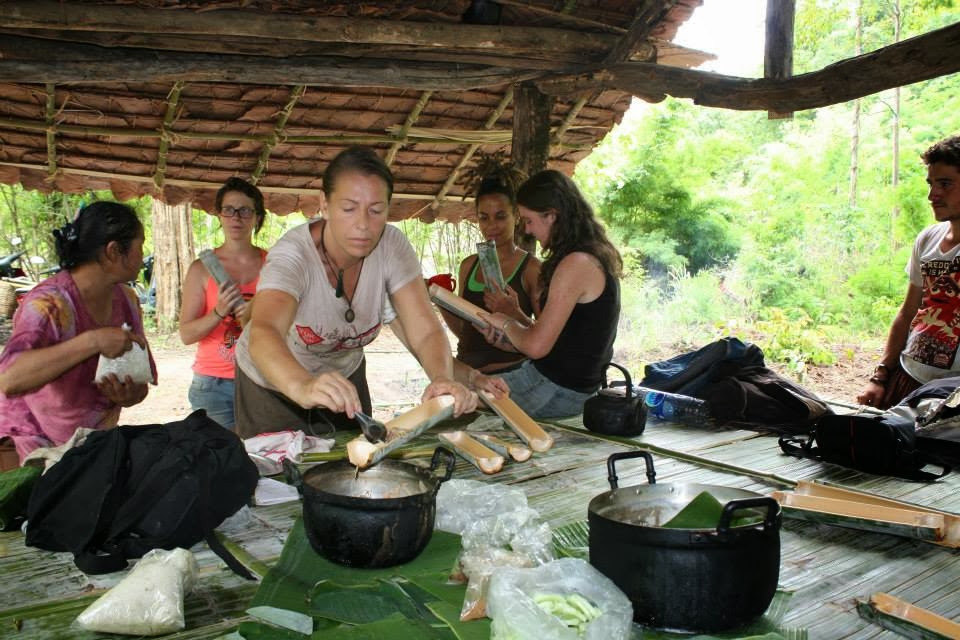 |
| Eating traditionally prepared rice and soup in bamboo bowls |
 |
| Demonstration of what these spices (left to right: galangal, chile, lemongrass, kaffir lime) look like when you should and shouldn't eat them |
 |
| Taste of Thailand in one bite |
Writing this post has made me so nostalgic for Thai food! Buying food at the markets or eating meals at inexpensive little cafes proved to me that healthy, fresh, simple foods can be available cheaply and readily. This really made me wonder why it is so impossible to have similar experiences in the U.S.. Why do all our food vendors need to be huge chains and why does our food have to come from so far away. The way we eat in the U.S. is destroying the health of our land and our people. I learned so much in Thailand, but the lessons in eating and preparing food really stand out. I have enjoyed trying to cook Thai foods at home and am happy to have been inspired to grow my own herbs, but I am really looking forward to returning to Thailand to learn even more about the food, culture, language, and ecosystems.
Friday, September 27, 2013
Long Run Food
Here is a well-known personal secret: I am not a morning person. I hate waking up, and I especially hate waking up earlier than 9am. I'm not a night-owl either; I don't like staying up later than 11pm. Basically, I am a sleep person - I may like being asleep more than being awake. I really do need to sleep 10 hours a day in order to feel fully rested. This may sound absurd, but the average amount of sleep needed by adult humans is 8 hours - if 8 hours is the average, some people must need more. I need more.
The reason I bring this up is because as much as I really love to sleep, I also love to run and be otherwise productive throughout the day. Many runners love getting up before everyone else to get some miles in before most people have even rolled out of bed. I don't really enjoy this. I do occasionally have to get up early in order to fit a run into my day, but I don't like it. Here in South Georgia, I really need to start runs at sunrise or shortly after if I want to run outside. I have been waiting and hoping for the day that it would be less than 95F at mid day so I could enjoy an afternoon run. This week it has been rainy and overcast everyday, and I have been so incredibly grateful. I started a 12 mile run at 4pm on Monday and smiled throughout the whole distance, because I had been able to sleep in that morning. I have always been an afternoon and evening runner, that is just my style, and I am ecstatic to get back to my regular schedule.
The problem that comes up with afternoon and evening running, is that you will have to eat at least 1 meal before you head out for the run. My stomach is generally grumpier than the average stomach, and sometimes very bad things happen on runs when I am not careful with what I eat beforehand (think about your worst running nightmares, they have happened to me). I have found that salads and smoothies are my best choices for breakfast and lunch if I am planning a longer distance later in the day. But, sometimes I just really want something warm for breakfast, especially if it is chilly and overcast for the first time in months. This is the way I was feeling on Monday, so I started going through my cabinets looking for something that would satisfy my craving and keep my belly happy on a long run. My eyes rested on the quinoa - perfect!
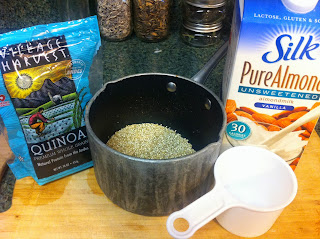 At first, I considered just making quinoa the way I normally would, which would make for a savory dish. But, really, I was in the mood for something a little sweet. I did a little googling, and found that breakfast quinoa is usually made with vanilla milk-substitute instead of water. I decided this was something worth trying. I combined a 1/4 cup of quinoa with one cup of unsweetened vanilla almond milk and a generous sprinkling of cinnamon. I let the mixture come to a boil and then lowered the heat until the mixture simmered. I kept the quinoa covered and simmering for about 15 minutes before adding chopped apples. After 5 minutes, I served myself and added a dash of cinnamon and maple syrup for presentation and sweetness. This was honestly one of the best all-day foods I have ever prepared (I had the leftovers for lunch).


 Later in the day, I was feeling like I needed a snack. This is reasonable considering I spent the day doing homework for my online climate science course and studying makes me just as hungry as running. I considered my options carefully. I knew my breakfast quinoa would be gentle on my belly - what could I snack on that would not ruin my good choice that morning? Based on what I had available, I decided to have an avocado, but I jazzed it up a bit. I put the avo in the food processor with some garlic and lime juice. I applied the avo spread to wasa whole grain crackers. The gluten in the wasa crackers may not have been the best choice, but it luckily wasn't bad enough to ruin my run.
 Sometimes what you eat after a run can be as important as what you eat before a run. I know 12 miles does not seem very long, but it is the longest I have ran in over a year, so I was expecting some aching and soreness the next day. Whenever I am training for a long distance race, I try to eat a good deal of spicy red pepper and turmeric for dinner on long run days. The capsaicin in chili spices reduces muscle pain and inflammation and turmeric further aids in reducing inflammation. I find that a good, spicy curry can make me feel a lot better the day after a long run than if I had pigged out on something less beneficial. For this evening's curry, I processed a white onion and 5 cloves of garlic in the food processor. I cooked the onion and garlic with coconut oil until they started to soften. For spice, I added copious amounts of cumin, curry powder, turmeric, and red cayenne pepper, and splashes and sprinkles of red pepper flakes, powdered ginger, and allspice. I let the spices simmer with the onions and garlic until my whole kitchen smelled strongly of curry. Next, I added carrots and cubed and pressed tofu. I allowed the tofu to brown a bit before adding a can of coconut milk, green peas, and chick peas that I had boiled for 10 min. After the coconut milk came to a boil, I lowered the heat to allow the curry to simmer for about 10 minutes. I poured the curry over some white jasmine rice we had left over and dug in!
The reason I bring this up is because as much as I really love to sleep, I also love to run and be otherwise productive throughout the day. Many runners love getting up before everyone else to get some miles in before most people have even rolled out of bed. I don't really enjoy this. I do occasionally have to get up early in order to fit a run into my day, but I don't like it. Here in South Georgia, I really need to start runs at sunrise or shortly after if I want to run outside. I have been waiting and hoping for the day that it would be less than 95F at mid day so I could enjoy an afternoon run. This week it has been rainy and overcast everyday, and I have been so incredibly grateful. I started a 12 mile run at 4pm on Monday and smiled throughout the whole distance, because I had been able to sleep in that morning. I have always been an afternoon and evening runner, that is just my style, and I am ecstatic to get back to my regular schedule.
The problem that comes up with afternoon and evening running, is that you will have to eat at least 1 meal before you head out for the run. My stomach is generally grumpier than the average stomach, and sometimes very bad things happen on runs when I am not careful with what I eat beforehand (think about your worst running nightmares, they have happened to me). I have found that salads and smoothies are my best choices for breakfast and lunch if I am planning a longer distance later in the day. But, sometimes I just really want something warm for breakfast, especially if it is chilly and overcast for the first time in months. This is the way I was feeling on Monday, so I started going through my cabinets looking for something that would satisfy my craving and keep my belly happy on a long run. My eyes rested on the quinoa - perfect!
 At first, I considered just making quinoa the way I normally would, which would make for a savory dish. But, really, I was in the mood for something a little sweet. I did a little googling, and found that breakfast quinoa is usually made with vanilla milk-substitute instead of water. I decided this was something worth trying. I combined a 1/4 cup of quinoa with one cup of unsweetened vanilla almond milk and a generous sprinkling of cinnamon. I let the mixture come to a boil and then lowered the heat until the mixture simmered. I kept the quinoa covered and simmering for about 15 minutes before adding chopped apples. After 5 minutes, I served myself and added a dash of cinnamon and maple syrup for presentation and sweetness. This was honestly one of the best all-day foods I have ever prepared (I had the leftovers for lunch).

 Later in the day, I was feeling like I needed a snack. This is reasonable considering I spent the day doing homework for my online climate science course and studying makes me just as hungry as running. I considered my options carefully. I knew my breakfast quinoa would be gentle on my belly - what could I snack on that would not ruin my good choice that morning? Based on what I had available, I decided to have an avocado, but I jazzed it up a bit. I put the avo in the food processor with some garlic and lime juice. I applied the avo spread to wasa whole grain crackers. The gluten in the wasa crackers may not have been the best choice, but it luckily wasn't bad enough to ruin my run.
Around 4, Gnasher and I set out for 12. It was cool, overcast, and drizzly, which made the weather as good as it gets in South Georgia. The first 6 miles went swimmingly. I had that feeling that I could run forever. At the 6 mile turn around point, I even found some stray watermelon growing at the edge of a cotton field. I bashed one open on the road and Gnasher and I enjoyed some refreshing watermelon. I hoped that this good find would rehydrate us and give us the sugar that we needed to stay energized through the rest of the run. I am notoriously bad at hydrating and fueling during runs. I love running because you really don't need anything but a pair of shoes (and many would argue you do't even need those). I resent carrying anything extra with me and would rather enjoy the freedom of heading out with just Gnasher's leash in my hand than bringing water and energy bars. I often suffer for this stubbornness, but sometimes I get lucky and find watermelons (or water fountains). I don't think Gnasher and I started feeling dehydrated until mile 9, but we still finished strong and I did not have any stomach issues (Thank Quinoa!).
 Sometimes what you eat after a run can be as important as what you eat before a run. I know 12 miles does not seem very long, but it is the longest I have ran in over a year, so I was expecting some aching and soreness the next day. Whenever I am training for a long distance race, I try to eat a good deal of spicy red pepper and turmeric for dinner on long run days. The capsaicin in chili spices reduces muscle pain and inflammation and turmeric further aids in reducing inflammation. I find that a good, spicy curry can make me feel a lot better the day after a long run than if I had pigged out on something less beneficial. For this evening's curry, I processed a white onion and 5 cloves of garlic in the food processor. I cooked the onion and garlic with coconut oil until they started to soften. For spice, I added copious amounts of cumin, curry powder, turmeric, and red cayenne pepper, and splashes and sprinkles of red pepper flakes, powdered ginger, and allspice. I let the spices simmer with the onions and garlic until my whole kitchen smelled strongly of curry. Next, I added carrots and cubed and pressed tofu. I allowed the tofu to brown a bit before adding a can of coconut milk, green peas, and chick peas that I had boiled for 10 min. After the coconut milk came to a boil, I lowered the heat to allow the curry to simmer for about 10 minutes. I poured the curry over some white jasmine rice we had left over and dug in!
I feel pretty pleased with the meals I prepared for this long run day, but I am most excited about my discovery of breakfast quinoa. I can tell that this will join the other staple dishes in my cooking repertoire. I am filing this one away in my brain, right next to raw green soup and pizza rainbows. My next long run is 14 miles on Monday and I have not yet decided if I will stick with this menu or if I will try some new pre-run meals, but I am definitely considering planting a water bottle and a larabar at the mile 7 turnaround. Here's hoping it is a miserable, chilly, overcast, and drizzly day on Monday so I can sleep all morning and head out for my run in the midafternoon!
Monday, September 9, 2013
I can can.
As proclaimed, I headed to the Valdosta Farm Days downtown grower's market this Saturday set to buy all the tomatoes available and can like mad. Strangely, it seemed my friends and I were the only people in town interested in the market this week. Almost none of the usual vendors had showed up and the town square was a ghost town! Only one vendor had any produce at all, and when it was my turn in line, there were only 5 tomatoes left. You know it is a strange day when there are not even onions or collards available at a growers market in southern Georgia! So, I bought my five tomatoes, along with some zucchini, peaches, cucumbers, a baking pumpkin, and local pork and venison sausages. It was better than nothing and I figured it was good to start small.
After being let down by the market, there was plenty of morning left, so we went searching for a local produce store we had heard rumors of: Carter's Market Produce and Meats. This store is like an organic and local food oasis in the Wal-Mart driven food desert of Southern Georgia. As I walked in, I immediately felt gratitude and excitement. There were some favorites like Rudi's organic bread, Bragg's apple cider vinegar, and Justin's Almond Butter that I had not been able to find here, but there was also a plethora of local organic zucchini, pumpkins, onions, tomatoes, meats, eggs (!!!), and cheeses. In addition, there was local honey, local olive oil, and locally roasted coffee. I am beyond ecstatic to have found this market!
.JPG) In a moment of self-doubt, I decided to stick with the five tomatoes I had already bought (what if I made gallons of sauce that tasted terrible or went bad?). I had originally planned to use Barbara Kingsolver's family tomato sauce recipe from her book Animal, Vegetable, Miracle, but her recipe calls for 30 lbs of tomatoes! My tomato cache weighed closer to 2.5 lbs, so I worked from several recipes I found on the internet along side Kingsolver's suggestions.
In a moment of self-doubt, I decided to stick with the five tomatoes I had already bought (what if I made gallons of sauce that tasted terrible or went bad?). I had originally planned to use Barbara Kingsolver's family tomato sauce recipe from her book Animal, Vegetable, Miracle, but her recipe calls for 30 lbs of tomatoes! My tomato cache weighed closer to 2.5 lbs, so I worked from several recipes I found on the internet along side Kingsolver's suggestions.
The first step in canning my own tomato sauce was to sterilize the canning jars and lids. There are several ways to do this: boiling them, running them through the dishwasher, or using a sterilizing solution. We use iodophor to sterilize everything when brewing beer and I assume that this would work for canning as well, but I could not find any sites recommending it, so I stuck to the traditional boiling for now. In the future, I think I will use the iodophor, it is much quicker and uses less energy (does not need to be heated).
Next up, the tomatoes needed to lose their skins and seeds. I found a site that suggested cutting an x on the bottom of the fruit and blanching them (dropping them in boiling water for 30 seconds and then in ice water for 30 seconds). I kind of couldn't believe how well this worked; the skins literally fell right off the tomatoes. Next, I cut them in wedges and pushed the seeds out and into my countertop compost container; turns out, canning preserves food and gives back to the soil. I chopped the tomatoes up a bit - how finely you chop them is a personal preference - and the tomatoes were ready for the pot.
.JPG)
.JPG)
.JPG)
.JPG)
Before I cooked the tomatoes, I softened some chopped onion with just a tiny bit of water in the bottom of a large pot. Once the onions were soft, I added the tomatoes to the pot, sprinkled in salt, pepper, garlic powder, thyme, cinnamon, and nutmeg. I brought the tomatoes to a boil, lowered to a simmer, and left for about 40 minutes, stirring occasionally. I have to admit, I was surprised how much water came from the tomatoes; when I read instructions to let the tomatoes reach a boil, I really thought it would be necessary to add water. As the sauce was approaching completion, I opened the sterilized jars just long enough to add 1/4 teaspoon of citric acid to each jar. When the sauce was done cooking, I ladled it into the sterilized pint jars with the citric acid and quickly covered them with the lids. I ended up only filling 2 pint jars with sauce, but there was some left over that Jamie and I gobbled up with a spoon as a sort of tomato soup. I was impressed; the sauce tasted really good at this point - the nutmeg and cinnamon brought just a tad of sweetness to a traditionally more savory flavor.
Finally, I put my two jars of tomato sauce in the giant enamel pot that we use for brewing, and filled it with enough water to cover the jars by one inch when they were standing up. Once the water reached a rolling boil, I started a timer for 35 minutes. I have to admit, I did stare at the the jars intermittently. Part of me was sure they were going to explode, but tiny air bubbles were released from the inner rim of the screw on ring relieving the pressure inside the jars. It was probably more than a little wasteful to boil that much water for two measly pint jars, but it was an experiment! In the future, I will do much larger batches at a time. Look out friends and family, jarred goods are coming your way for the holidays this year! After what seemed like forever, my timer went off and I pulled the two jars out of the boiling water and set them to cool on the counter top. Their tops were vacuumed down strongly and they were sealed shut! It had worked. My two beautiful jars are in my pantry right now, waiting for a future pasta night!
.JPG) After finishing this project, I was feeling quite prideful. Canning was simple and straightforward, but it was something that I never did before and never really expected to do. I did not grow up in a canning household. In fact, this was the first time I even made tomato sauce from scratch. Usually, I cook onions and garlic in olive oil and then add carrots and some other veggies like zucchini or whatever we have, pour in a jar of store bought sauce, and finally stir in some spinach until it wilts - voila! tomato sauce! Despite everything that I add to it, my recipe relies on a $3.50 jar of Newman's own sauce. I just can't believe how easy and affordable it is to make my own jars of tomato sauce. And, in doing so, I am supporting local farmers and decreasing the carbon footprint of my meal. I have the canning bug now; I want to can everything!
After finishing this project, I was feeling quite prideful. Canning was simple and straightforward, but it was something that I never did before and never really expected to do. I did not grow up in a canning household. In fact, this was the first time I even made tomato sauce from scratch. Usually, I cook onions and garlic in olive oil and then add carrots and some other veggies like zucchini or whatever we have, pour in a jar of store bought sauce, and finally stir in some spinach until it wilts - voila! tomato sauce! Despite everything that I add to it, my recipe relies on a $3.50 jar of Newman's own sauce. I just can't believe how easy and affordable it is to make my own jars of tomato sauce. And, in doing so, I am supporting local farmers and decreasing the carbon footprint of my meal. I have the canning bug now; I want to can everything!
After being let down by the market, there was plenty of morning left, so we went searching for a local produce store we had heard rumors of: Carter's Market Produce and Meats. This store is like an organic and local food oasis in the Wal-Mart driven food desert of Southern Georgia. As I walked in, I immediately felt gratitude and excitement. There were some favorites like Rudi's organic bread, Bragg's apple cider vinegar, and Justin's Almond Butter that I had not been able to find here, but there was also a plethora of local organic zucchini, pumpkins, onions, tomatoes, meats, eggs (!!!), and cheeses. In addition, there was local honey, local olive oil, and locally roasted coffee. I am beyond ecstatic to have found this market!
.JPG) In a moment of self-doubt, I decided to stick with the five tomatoes I had already bought (what if I made gallons of sauce that tasted terrible or went bad?). I had originally planned to use Barbara Kingsolver's family tomato sauce recipe from her book Animal, Vegetable, Miracle, but her recipe calls for 30 lbs of tomatoes! My tomato cache weighed closer to 2.5 lbs, so I worked from several recipes I found on the internet along side Kingsolver's suggestions.
In a moment of self-doubt, I decided to stick with the five tomatoes I had already bought (what if I made gallons of sauce that tasted terrible or went bad?). I had originally planned to use Barbara Kingsolver's family tomato sauce recipe from her book Animal, Vegetable, Miracle, but her recipe calls for 30 lbs of tomatoes! My tomato cache weighed closer to 2.5 lbs, so I worked from several recipes I found on the internet along side Kingsolver's suggestions.The first step in canning my own tomato sauce was to sterilize the canning jars and lids. There are several ways to do this: boiling them, running them through the dishwasher, or using a sterilizing solution. We use iodophor to sterilize everything when brewing beer and I assume that this would work for canning as well, but I could not find any sites recommending it, so I stuck to the traditional boiling for now. In the future, I think I will use the iodophor, it is much quicker and uses less energy (does not need to be heated).
Next up, the tomatoes needed to lose their skins and seeds. I found a site that suggested cutting an x on the bottom of the fruit and blanching them (dropping them in boiling water for 30 seconds and then in ice water for 30 seconds). I kind of couldn't believe how well this worked; the skins literally fell right off the tomatoes. Next, I cut them in wedges and pushed the seeds out and into my countertop compost container; turns out, canning preserves food and gives back to the soil. I chopped the tomatoes up a bit - how finely you chop them is a personal preference - and the tomatoes were ready for the pot.
.JPG)
.JPG)
.JPG)
.JPG)
Before I cooked the tomatoes, I softened some chopped onion with just a tiny bit of water in the bottom of a large pot. Once the onions were soft, I added the tomatoes to the pot, sprinkled in salt, pepper, garlic powder, thyme, cinnamon, and nutmeg. I brought the tomatoes to a boil, lowered to a simmer, and left for about 40 minutes, stirring occasionally. I have to admit, I was surprised how much water came from the tomatoes; when I read instructions to let the tomatoes reach a boil, I really thought it would be necessary to add water. As the sauce was approaching completion, I opened the sterilized jars just long enough to add 1/4 teaspoon of citric acid to each jar. When the sauce was done cooking, I ladled it into the sterilized pint jars with the citric acid and quickly covered them with the lids. I ended up only filling 2 pint jars with sauce, but there was some left over that Jamie and I gobbled up with a spoon as a sort of tomato soup. I was impressed; the sauce tasted really good at this point - the nutmeg and cinnamon brought just a tad of sweetness to a traditionally more savory flavor.
Finally, I put my two jars of tomato sauce in the giant enamel pot that we use for brewing, and filled it with enough water to cover the jars by one inch when they were standing up. Once the water reached a rolling boil, I started a timer for 35 minutes. I have to admit, I did stare at the the jars intermittently. Part of me was sure they were going to explode, but tiny air bubbles were released from the inner rim of the screw on ring relieving the pressure inside the jars. It was probably more than a little wasteful to boil that much water for two measly pint jars, but it was an experiment! In the future, I will do much larger batches at a time. Look out friends and family, jarred goods are coming your way for the holidays this year! After what seemed like forever, my timer went off and I pulled the two jars out of the boiling water and set them to cool on the counter top. Their tops were vacuumed down strongly and they were sealed shut! It had worked. My two beautiful jars are in my pantry right now, waiting for a future pasta night!
.JPG) After finishing this project, I was feeling quite prideful. Canning was simple and straightforward, but it was something that I never did before and never really expected to do. I did not grow up in a canning household. In fact, this was the first time I even made tomato sauce from scratch. Usually, I cook onions and garlic in olive oil and then add carrots and some other veggies like zucchini or whatever we have, pour in a jar of store bought sauce, and finally stir in some spinach until it wilts - voila! tomato sauce! Despite everything that I add to it, my recipe relies on a $3.50 jar of Newman's own sauce. I just can't believe how easy and affordable it is to make my own jars of tomato sauce. And, in doing so, I am supporting local farmers and decreasing the carbon footprint of my meal. I have the canning bug now; I want to can everything!
After finishing this project, I was feeling quite prideful. Canning was simple and straightforward, but it was something that I never did before and never really expected to do. I did not grow up in a canning household. In fact, this was the first time I even made tomato sauce from scratch. Usually, I cook onions and garlic in olive oil and then add carrots and some other veggies like zucchini or whatever we have, pour in a jar of store bought sauce, and finally stir in some spinach until it wilts - voila! tomato sauce! Despite everything that I add to it, my recipe relies on a $3.50 jar of Newman's own sauce. I just can't believe how easy and affordable it is to make my own jars of tomato sauce. And, in doing so, I am supporting local farmers and decreasing the carbon footprint of my meal. I have the canning bug now; I want to can everything! Friday, September 6, 2013
Kingsolver's localism, sweet as zucchini cookies
I just finished reading Barbara Kingsolver's Animal, Vegetable, Miracle (Animal, Vegetable, Miracle) and it has inspired reflection, cooking, and future projects on the horizon. I am a long time fan of Barbara's (I feel like she is now my pal after reading this year long journal); I was first introduced to her writing more than ten years ago, when I read The Poisonwood Bible for a High School english class. Over the years, I have devoured her other books, enjoying the mix of human relationships, science, environmentalism, and feminism. My obvious favorite is Prodigal Summer, and this novel likely had a role in my fascination (obsession?) with farming. In AVM, Barbara in effect plays out Prodigal Summer and moves her family from the urban desert of Tucson back to her roots in Southern Appalachia to embark on a year long hyper local eating project.
The book begins as Barbara, her husband Steven, 18 year old daughter Camille, and 4th grader Lily pile into their family car and start driving East. Upon leaving Tucson, Barbara waxes poetic on all that Tucson has to offer. Basically Tucson is a pretty fabulous place to live, if it only had more water. As she mentioned universities, museums, and other urban treasures, I couldn't help but feel a little bitter that Jamie and I were stationed here in Georgia rather than in Tucson. But, here was Barbara Kingsolver abandoning Tucson and heading to the American South!
Once at the Farm house in Virginia, the family set to work fixing up the house and preparing for the upcoming planting season and the commencement of their year of eating solely local food. As the spring began and crops began being planted and harvested, the book became part garden and farm journal, part food diary, and part exposé on the cruelties of industrial farming. I have to say that the book was rather winding and there were a lot of tangents. Occasionally, I found myself a bit distracted, wondering if I would ever finish the book. Part of the problem for me was that the majority of the shocking exposed secrets of industrial farming and U.S. farm policy were not new news for me. The first time that I learned these truths, however, I was rapt, so it is not fair to hold this against Barbara. The information is of high quality and well presented, just nothing novel or terrifying. Upon further reflection, I also realized that this book is chronicling an undertaking that required a huge amount of physical labor. From my experience working on a farm, I know that type of work can often feel like drudgery. So, I suppose that it makes sense that reading about it can sometimes feel similar.
Despite respites of boredom, I did enjoy the glimpse into Barbara's family's dedication to a noble cause and all the hard work that went into their success. Not too secretly, I long for a homestead that is self sustainable and this book deepened those longings and also made me feel a tad guilty that I was not doing more now. I have a ton of land in my backyard, mostly full sun, that is not being used for anything, save for my dogs stomping ground (he really likes stomping). My garden is rather pathetic, with only a few plants, and my 3 chickens are not even laying eggs yet. My excuse has been that we are moving soon and it is not worth all the work to create growing spaces. The next family that lives here would probably prefer grass, anyways. But, the book provides some really fabulous ideas about living more sustainably and eating locally that would not require me to till my entire backyard.
Two of the ideas that appealed to me most, that would not be terribly difficult or expensive and could make a big difference, are canning and baking bread. The book correctly identifies that for many of us, it is relatively easy to eat mostly local in the summer, when farmer's markets are in season, but it is more difficult to eat locally in the winter when markets are closed. The Kingsolvers can their own vegetables, but it would be just as local to buy up all the tomatoes at the farmer's market and can them, so you can have local tomatoes and sauces in the winter. The Kingsolvers also grew a huge over-abundance of zucchini. They tried their best to eat it and give it away to friends, but there was just too much. Not wanting to create waste, they shredded the zucchini and stored it in freezer bags to be used in breads and cookies all year round. In addition to specific instructions on how to can tomato sauce, diced tomatoes, chutneys, and salsas, the book also included an amazing recipe for zucchini chocolate chip cookies (see below). Other vegetables, like greens and broccoli, can be blanched and frozen in freezer bags. Tomorrow is the next farmers market in downtown Valdosta (Valdosta Farm Days), and I plan on stocking up on local veggies and trying out the canning process for the first time this weekend.
I am also looking into buying a bread machine. It appears that I can buy a decent machine for about $60, which is the price of 20 loaves of bread at $3 a loaf. If Jamie and I eat a loaf of bread every week, the machine will pay for itself in 20 weeks, or 5 months. Furthermore, we are having trouble finding bread without high fructose corn syrup and specialty healthy breads like spelt or whole grain in Valdosta supermarkets. Baking our own bread would solve that problem, as well. I haven't placed the order yet, but it is on my mind and there is an amazon tab open in my browser.
Since I couldn't head straight to the farmer's market or start baking bread as soon as I finished "Animal, Vegetable, Miracle," I decided to try out the zucchini chocolate chip cookie recipe instead. I am glad I did. Jamie was skeptical of these cookies when he observed the bits of green, but seemed to forget all about them once he indulged in a cookie (and then another). I modified the original recipe to be dairy-free and only used white flour, rather than half whole wheat, because I did not have whole wheat flour in the cabinet and wanted the cookies right away. The modifications worked out deliciously.
Ingredients
The wet stuff
1 egg, beaten
1/2 cup canola oil
1/2 cup dark brown sugar
1/3 cup honey
1 tablespoon pure vanilla extract (real)
The dry stuff
2 cups all purpose flour
1/2 teaspoon baking soda
1/4 teaspoon salt
1/4 teaspoon cinnamon
1/4 teaspoon nutmeg
The good stuff
1 cup finely shredded zucchini
12 oz. dark chocolate chips
Procedure
1. Preheat oven to 350F
.JPG)
2. Combine the wet stuff in a large mixing bowl; I used my new Kitchen Aid mixer bowl for this (thanks again, Mom!). I used honey that we purchased from an apiary near Jamie's grandparents house in upstate New York. This honey is extra flavorful, and I attribute at least part of the success of this recipe to the magnificent local honey.
.JPG)
3. Combine the dry stuff in a separate mixing bowl. Stir the ingredients with a fork until they are evenly mixed.

4. Stir half the dry stuff into the wet stuff. Mix thoroughly before adding the second half of the dry ingredients, and again mix thoroughly.
5. Add the good stuff into the mixture and continue mixing until evenly dispersed.
.JPG) 6. Drop spoonfuls of batter onto greased cookie sheets (unless you have parchment paper handy, which is a better choice). The recipe should make about two dozen cookies, if you don't eat too much batter. I only got 20 cookies out of the recipe...
6. Drop spoonfuls of batter onto greased cookie sheets (unless you have parchment paper handy, which is a better choice). The recipe should make about two dozen cookies, if you don't eat too much batter. I only got 20 cookies out of the recipe...
7. Cook at 350F for 10-12 minutes or until brown around the edges.
8. Remove cookies from cookie sheets and place on cooling racks to prevent burning.
.JPG)
9. Cookies will be soft, spongy, and cake-like. Enjoy!! Share with your friends... or eat them all.
.JPG)
The book begins as Barbara, her husband Steven, 18 year old daughter Camille, and 4th grader Lily pile into their family car and start driving East. Upon leaving Tucson, Barbara waxes poetic on all that Tucson has to offer. Basically Tucson is a pretty fabulous place to live, if it only had more water. As she mentioned universities, museums, and other urban treasures, I couldn't help but feel a little bitter that Jamie and I were stationed here in Georgia rather than in Tucson. But, here was Barbara Kingsolver abandoning Tucson and heading to the American South!
Once at the Farm house in Virginia, the family set to work fixing up the house and preparing for the upcoming planting season and the commencement of their year of eating solely local food. As the spring began and crops began being planted and harvested, the book became part garden and farm journal, part food diary, and part exposé on the cruelties of industrial farming. I have to say that the book was rather winding and there were a lot of tangents. Occasionally, I found myself a bit distracted, wondering if I would ever finish the book. Part of the problem for me was that the majority of the shocking exposed secrets of industrial farming and U.S. farm policy were not new news for me. The first time that I learned these truths, however, I was rapt, so it is not fair to hold this against Barbara. The information is of high quality and well presented, just nothing novel or terrifying. Upon further reflection, I also realized that this book is chronicling an undertaking that required a huge amount of physical labor. From my experience working on a farm, I know that type of work can often feel like drudgery. So, I suppose that it makes sense that reading about it can sometimes feel similar.
Despite respites of boredom, I did enjoy the glimpse into Barbara's family's dedication to a noble cause and all the hard work that went into their success. Not too secretly, I long for a homestead that is self sustainable and this book deepened those longings and also made me feel a tad guilty that I was not doing more now. I have a ton of land in my backyard, mostly full sun, that is not being used for anything, save for my dogs stomping ground (he really likes stomping). My garden is rather pathetic, with only a few plants, and my 3 chickens are not even laying eggs yet. My excuse has been that we are moving soon and it is not worth all the work to create growing spaces. The next family that lives here would probably prefer grass, anyways. But, the book provides some really fabulous ideas about living more sustainably and eating locally that would not require me to till my entire backyard.
Two of the ideas that appealed to me most, that would not be terribly difficult or expensive and could make a big difference, are canning and baking bread. The book correctly identifies that for many of us, it is relatively easy to eat mostly local in the summer, when farmer's markets are in season, but it is more difficult to eat locally in the winter when markets are closed. The Kingsolvers can their own vegetables, but it would be just as local to buy up all the tomatoes at the farmer's market and can them, so you can have local tomatoes and sauces in the winter. The Kingsolvers also grew a huge over-abundance of zucchini. They tried their best to eat it and give it away to friends, but there was just too much. Not wanting to create waste, they shredded the zucchini and stored it in freezer bags to be used in breads and cookies all year round. In addition to specific instructions on how to can tomato sauce, diced tomatoes, chutneys, and salsas, the book also included an amazing recipe for zucchini chocolate chip cookies (see below). Other vegetables, like greens and broccoli, can be blanched and frozen in freezer bags. Tomorrow is the next farmers market in downtown Valdosta (Valdosta Farm Days), and I plan on stocking up on local veggies and trying out the canning process for the first time this weekend.
I am also looking into buying a bread machine. It appears that I can buy a decent machine for about $60, which is the price of 20 loaves of bread at $3 a loaf. If Jamie and I eat a loaf of bread every week, the machine will pay for itself in 20 weeks, or 5 months. Furthermore, we are having trouble finding bread without high fructose corn syrup and specialty healthy breads like spelt or whole grain in Valdosta supermarkets. Baking our own bread would solve that problem, as well. I haven't placed the order yet, but it is on my mind and there is an amazon tab open in my browser.
Since I couldn't head straight to the farmer's market or start baking bread as soon as I finished "Animal, Vegetable, Miracle," I decided to try out the zucchini chocolate chip cookie recipe instead. I am glad I did. Jamie was skeptical of these cookies when he observed the bits of green, but seemed to forget all about them once he indulged in a cookie (and then another). I modified the original recipe to be dairy-free and only used white flour, rather than half whole wheat, because I did not have whole wheat flour in the cabinet and wanted the cookies right away. The modifications worked out deliciously.
Ingredients
The wet stuff
1 egg, beaten
1/2 cup canola oil
1/2 cup dark brown sugar
1/3 cup honey
1 tablespoon pure vanilla extract (real)
The dry stuff
2 cups all purpose flour
1/2 teaspoon baking soda
1/4 teaspoon salt
1/4 teaspoon cinnamon
1/4 teaspoon nutmeg
The good stuff
1 cup finely shredded zucchini
12 oz. dark chocolate chips
Procedure
1. Preheat oven to 350F
.JPG)
2. Combine the wet stuff in a large mixing bowl; I used my new Kitchen Aid mixer bowl for this (thanks again, Mom!). I used honey that we purchased from an apiary near Jamie's grandparents house in upstate New York. This honey is extra flavorful, and I attribute at least part of the success of this recipe to the magnificent local honey.
.JPG)
3. Combine the dry stuff in a separate mixing bowl. Stir the ingredients with a fork until they are evenly mixed.

4. Stir half the dry stuff into the wet stuff. Mix thoroughly before adding the second half of the dry ingredients, and again mix thoroughly.
5. Add the good stuff into the mixture and continue mixing until evenly dispersed.
.JPG)
7. Cook at 350F for 10-12 minutes or until brown around the edges.
8. Remove cookies from cookie sheets and place on cooling racks to prevent burning.
.JPG)
9. Cookies will be soft, spongy, and cake-like. Enjoy!! Share with your friends... or eat them all.
.JPG)
Wednesday, August 28, 2013
Yoga Meets Science: Focus
While reading the September 2013 issue of Yoga Journal, the title of the month's wisdom section, "On the right track: When questions arise in your meditation practice, expert advice can help you go deeper," immediately caught my attention (http://www.yogajournal.com/wisdom/2656). Asana, or yoga poses, are fun and challenging in an exciting and easily accessible way for me. The more subtle aspects of yoga, like meditation, are much more difficult for me, and I struggle with sitting still for even a couple minutes. I read on with the hope of learning some new insight that may help me enjoy meditation more or attain greater benefits from the practice. Unfortunately, I was just one paragraph into the article when it stirred up a fair bit of vritti (distracting thoughts) for me that stole my attention from the rest of the article.
I could paraphrase, but I think it would be easier to just quote the paragraph here:
"Why meditation works is something of a mystery. But it's no longer a secret that meditation is good for us. Neuroscience can now show us what happens in the brain when we meditate. (Among other things, brain areas associated with stress slow down, and parts of the brain associated with feelings like joy, peace, and compassion become active.) The evidence that meditation triggers positive changes is overwhelming. In addition, we are beginning to recognize that meditation is a natural state, a current of awareness that wants to open up to us if only we'll let it."
My issue with this paragraph is that it is so vague. It basically says that it is hard to understand how meditation helps us, but science says it is true, never mind what science. This paragraph, despite citing that proof exists, gives me the same feeling that other meditation articles have: that meditation is good for you in a spiritual way. This leaves me wanting more. Having a scientific mind, I can't help but question these types of proclamations. I have been in so many yoga classes where a teacher will claim some magical power of a pose that I can't help but analyze and consider whether it is biologically possible. This steals my mind away from my practice and both annoys and frustrates me. Yoga does have scientifically proven benefits and when teachers spout seemingly magical, unsupported benefits it makes yoga seem less legitimate.
This frustration led me to research the scientific benefits of meditation. In the Yoga Sutras, there are eight parts or "limbs" of yoga: Yamas, Niyamas, Asana, Pranayama, Pratyahara, Dharana, Dhyana, and Samadhi. The practices do not need to be practiced one at a time in this order, but in order to fully accomplish the 8th limb, Samadhi or understanding, it is rather important to have practiced the first 7 pretty extensively. The Yamas and Niyamas are guidelines for living a virtuous life. Asana is the physical practice of yoga poses and Pranayama is the control of the breath. Together, Asana and Pranayama prepare the physical body to support the mental work of practicing Pratyahara, Dharana, Dhyana, and Samadhi. Pratyahara is the first step in yogic meditation and involves sensing the world around us without attaching thoughts and feelings to our perceptions. This practice can help eliminate external distractions in further meditation. Dharana, or concentration is the meditation that I practice and also for which the most scientific studies have been conducted. Dharana is meant to train the mind to focus on one thing at a time and to allow the practitioner to decide what the mind focuses on. This is a skill I certainly have not perfected, but that seems more than worthwhile. Imagine a life without succumbing to distraction and procrastination? Dhyana, or contemplation, and Samadhi, understanding, do not necessarily require perfect concentration, but it would probably help. Understanding the science behind Dharana makes the practice even more attractive to me.
Dharana, the 6th limb of the 8 limbs of Raja Yoga, is introduced in Sutra 3.1 of The Yoga Sutras. Patanjali defines Dharana as the “binding of the mind to one place, object, or idea.” In practice, Dharana is often described as concentration on a single thought, object, experience, or emotion. When the mind inevitably wanders, the practitioner gently redirects the mind back to what it is focusing on (Carrera, 383, 371). Especially in the modern world, the mind is constantly distracted and rarely gives its full attention to any one thing. The mind is distracted by birds flying by, cars honking on the street, cell phones ringing, emails dinging, our memories, concerns, worries, and anxieties; the mind is constantly giving attention to a multitude of distractions. In order to fully understand something or truly complete a task in a quality manner, it is necessary to focus and give undivided attention. The more distracted one is, the more difficult it is to learn and produce. Dharana trains the mind to be able to focus amid a plethora of distractions. It is like exercise for the mind (Jerard). The chronicle of anecdotal evidence of practicing Dharana having a positive effect on the mind and life of the practitioner is available from 2400 years ago and probably beyond. As evidence, consider this excerpt from the Bhagavad Gita (6.6): “As you gain control of your mind with the help of your higher Self, then your mind and ego become your allies. But the uncontrolled mind behaves as an enemy.” In modernity, scientific method has been applied to try to explain and better understand the benefits of Dharana and other meditative practices. The brain is so complex, however, that the benefits of Dharana and other types of meditation are not yet completely illuminated. But, scientists are learning more about the brain everyday and eventually even the tiniest subtleties of meditation will be scientifically understandable.
I could paraphrase, but I think it would be easier to just quote the paragraph here:
"Why meditation works is something of a mystery. But it's no longer a secret that meditation is good for us. Neuroscience can now show us what happens in the brain when we meditate. (Among other things, brain areas associated with stress slow down, and parts of the brain associated with feelings like joy, peace, and compassion become active.) The evidence that meditation triggers positive changes is overwhelming. In addition, we are beginning to recognize that meditation is a natural state, a current of awareness that wants to open up to us if only we'll let it."
My issue with this paragraph is that it is so vague. It basically says that it is hard to understand how meditation helps us, but science says it is true, never mind what science. This paragraph, despite citing that proof exists, gives me the same feeling that other meditation articles have: that meditation is good for you in a spiritual way. This leaves me wanting more. Having a scientific mind, I can't help but question these types of proclamations. I have been in so many yoga classes where a teacher will claim some magical power of a pose that I can't help but analyze and consider whether it is biologically possible. This steals my mind away from my practice and both annoys and frustrates me. Yoga does have scientifically proven benefits and when teachers spout seemingly magical, unsupported benefits it makes yoga seem less legitimate.
This frustration led me to research the scientific benefits of meditation. In the Yoga Sutras, there are eight parts or "limbs" of yoga: Yamas, Niyamas, Asana, Pranayama, Pratyahara, Dharana, Dhyana, and Samadhi. The practices do not need to be practiced one at a time in this order, but in order to fully accomplish the 8th limb, Samadhi or understanding, it is rather important to have practiced the first 7 pretty extensively. The Yamas and Niyamas are guidelines for living a virtuous life. Asana is the physical practice of yoga poses and Pranayama is the control of the breath. Together, Asana and Pranayama prepare the physical body to support the mental work of practicing Pratyahara, Dharana, Dhyana, and Samadhi. Pratyahara is the first step in yogic meditation and involves sensing the world around us without attaching thoughts and feelings to our perceptions. This practice can help eliminate external distractions in further meditation. Dharana, or concentration is the meditation that I practice and also for which the most scientific studies have been conducted. Dharana is meant to train the mind to focus on one thing at a time and to allow the practitioner to decide what the mind focuses on. This is a skill I certainly have not perfected, but that seems more than worthwhile. Imagine a life without succumbing to distraction and procrastination? Dhyana, or contemplation, and Samadhi, understanding, do not necessarily require perfect concentration, but it would probably help. Understanding the science behind Dharana makes the practice even more attractive to me.
Dharana, the 6th limb of the 8 limbs of Raja Yoga, is introduced in Sutra 3.1 of The Yoga Sutras. Patanjali defines Dharana as the “binding of the mind to one place, object, or idea.” In practice, Dharana is often described as concentration on a single thought, object, experience, or emotion. When the mind inevitably wanders, the practitioner gently redirects the mind back to what it is focusing on (Carrera, 383, 371). Especially in the modern world, the mind is constantly distracted and rarely gives its full attention to any one thing. The mind is distracted by birds flying by, cars honking on the street, cell phones ringing, emails dinging, our memories, concerns, worries, and anxieties; the mind is constantly giving attention to a multitude of distractions. In order to fully understand something or truly complete a task in a quality manner, it is necessary to focus and give undivided attention. The more distracted one is, the more difficult it is to learn and produce. Dharana trains the mind to be able to focus amid a plethora of distractions. It is like exercise for the mind (Jerard). The chronicle of anecdotal evidence of practicing Dharana having a positive effect on the mind and life of the practitioner is available from 2400 years ago and probably beyond. As evidence, consider this excerpt from the Bhagavad Gita (6.6): “As you gain control of your mind with the help of your higher Self, then your mind and ego become your allies. But the uncontrolled mind behaves as an enemy.” In modernity, scientific method has been applied to try to explain and better understand the benefits of Dharana and other meditative practices. The brain is so complex, however, that the benefits of Dharana and other types of meditation are not yet completely illuminated. But, scientists are learning more about the brain everyday and eventually even the tiniest subtleties of meditation will be scientifically understandable.
There have been upwards of hundreds of scientific studies
investigating whether meditation truly improves focus and attention, and not particularly surprisingly, the
majority of the studies have found that it does (Williams 2009). In peer
reviewed psychological and medical journals, studies have found decreased heart
rate, breathing rate and oxygen intake during meditation, showing that
meditation produces a state of calmness and decreased metabolic rate (Corby 1978). Cognitive studies
have shown that practitioners of concentration meditation, such as Dharana, perform
better on attention based tasks and are not as easily distracted by external
stimuli (Chan & Wolcott 2007). Practitioners of concentration meditation
are also able to detect and observe fast moving stimuli that non-practitioners
do not perceive (Lutz et al. 2008). Additionally, concentration meditation has
been found to provide supplementary benefits in the treatment of stress, mood,
and anxiety symptoms, as well as epilepsy (Chiesa & Seretti 2009). Rigorous
scientific study has shown that the anecdotal evidence of the benefits
concentration meditation are real, but how they manifest is a much tougher
question.
There are several techniques used to analyze the brain and
brain function. Functional Magnetic Resonance Imaging or fMRI measures the amount of oxygen in the brain as a result of cerebral blood flow. It is assumed
that the region that is most active at a given time is the most oxygenated at
that time. Researchers are able to estimate the amount of neural activity in a
location in the brain during a specific activity and therefore can determine
which regions are functionally associated with different behaviors. fMRI is one tool that has been used to try to understand what is happening in the brain
during meditation. For example, fMRI was used to analyze the brains of practitioners of
concentration meditation while they silently repeated a two-phrase mantra in
time with their breath. As a control, the same participants' brains were also
analyzed while they sat quietly and thought up lists of different types of
animals. Compared to the control scenario, more mental activity was seen in the anterior
cingulated cortex during meditation. In later stages of meditation, more activity was also seen
in the frontal, parietal, and temporal lobes than in the control state. These
results suggest meditation activates locations in the brain that are commonly
associated with attention and control of the autonomic nervous system (Williams
2009).
Electroencephalograms or EEGs measure brain activity by
recording brain waves which are a result of electrical activity in the brain.
There are five types of brainwaves categorized by their frequency measured in Hertz (Hz) or cycles per second. Delta waves (1-3Hz) are the
slowest waves and are characteristic of a very deep sleep. Theta waves ( 4-7Hz)
are seen during a light sleep or when we are feeling drowsy. Alpha waves
(8-10Hz) are present during relaxed awareness, when we are not involved in deep
thought. Beta waves (13-29Hz) are present when we are actively thinking, alert,
and attentive. Gamma waves (30-80Hz) are present when we are mentally
integrating and processing complex sensory information (Williams 2009). Changes
in brain wave activity associated with different types of meditation has been
actively studied since the 1970’s. One early study (Corby et al. 1978), found
that when concentration meditation practitioners sat in lotus pose (cross-legged with the tops of the feet placed on top of the thighs) and focused on a
mantra, there was an increase in alpha and theta waves along the central
midline of the brain. Control participants relaxed to the point of falling
asleep, but the pattern in brain wave activity observed in the meditation
practitioners was not observed in the control participants. Those that were meditating maintained a state just on the cusp of waking and sleeping. Additionally, the
change in brain wave activity lingered after meditation was discontinued, which was not the case for control participants. This study suggests that meditation is accompanied by a decrease in distracted thinking that is carried with the practitioner after ceasing to meditate.
Increased theta and alpha activity along the central midline
of the brain and the frontal lobe explains the sense of calmness felt when
meditating, but these regions are also associated with attention and mental
concentration. When advanced meditation practitioners are compared to novice
practitioners, those that are advanced are more able to produce and maintain
alpha and theta rhythms in the midline and frontal cortex of the brain. This
suggests that advanced practitioners of concentration meditation have refined
their brain processes to such a point that they are capable of controlling brain
processes in a coherent and voluntary manner (Williams 2007). Furthermore, in a
study published in Nature by Draganski et al. (2004), results were shared that
suggest regular practice induces training related changes in the grey
matter of the cerebral cortex. These changes are similar to when someone learns
a new complex skill, like juggling. The changes observed in the cerebral cortex
grey matter suggests there is a level of flexibility in how the brain is
structured and that it can actually be restructured through persistent practice
(Draganski et al 2004). This plasticity of brain matter and the reshaping and restructuring of our brains through conscious effort is a hot topic that is currently being investigated in regards to many different illnesses. Since meditation can tap into our brains natural ability to restructure itself, meditation may be used in treating brain disorders in the future.
According to scientific literature that has been published
thus far, Dharana, or concentration on a single object, experience, or feeling
increases attention and focus through practice. Dharana activates parts of the
brain associated with attention and creates low frequency brainwaves associated
with relaxation. Perhaps most importantly, advanced practitioners are more able to create and maintain
these brainwave patterns. Dharana is essentially training for the brain to
cultivate an ability to maintain focus and resist distractions and the science clearly supports this claim.
So, sit down and try it! Find a quiet space with minimal distractions. Sit in a way that will allow you to stay seated with a long, virtuous spine for a period of time without being physically uncomfortable. Some suggestions are kneeling with a pillow between your butt and heels, kneeling on a pillow, sitting cross-legged on a cushion or with the sit bones on a folded blanket and the legs on the floor. Anyway that you feel supported and comfortable is the right way to sit; it is absolutely not necessary to sit in lotus to meditate. Choose one thing to focus on. I usually choose a simple word like "Om" or "Shanti" and repeat it over and over in my mind. You can focus on the one thing in whatever way you like, as long as you keep that one thing in mind. Whenever your mind wanders, notice the transgression, and bring your attention back to your object of meditation. It helps to set a timer so that you are not wondering how long it has been. Start with 1 minute a day. You will likely be surprised how hard it is to focus for just one minute! This is why Dharana is a practice. Keep at it and you will likely notice the benefits discussed in this post.
So, sit down and try it! Find a quiet space with minimal distractions. Sit in a way that will allow you to stay seated with a long, virtuous spine for a period of time without being physically uncomfortable. Some suggestions are kneeling with a pillow between your butt and heels, kneeling on a pillow, sitting cross-legged on a cushion or with the sit bones on a folded blanket and the legs on the floor. Anyway that you feel supported and comfortable is the right way to sit; it is absolutely not necessary to sit in lotus to meditate. Choose one thing to focus on. I usually choose a simple word like "Om" or "Shanti" and repeat it over and over in my mind. You can focus on the one thing in whatever way you like, as long as you keep that one thing in mind. Whenever your mind wanders, notice the transgression, and bring your attention back to your object of meditation. It helps to set a timer so that you are not wondering how long it has been. Start with 1 minute a day. You will likely be surprised how hard it is to focus for just one minute! This is why Dharana is a practice. Keep at it and you will likely notice the benefits discussed in this post.
Works Sited
Carrere, Jaganath. “Inside the Yoga Sutras. ” Integral Yoga
Publications, Buckingham, Virginia; 2006.
Chiesa, A., & Serretti, A. (2009). Mindfulness-based
stress reduction for stress management in healthy people: A review and
meta-analysis. Journal of Alternative and
Complementary Medicine, 15, 593 –
600.
Chan, D., & Woollacott, M. (2007). Effects of level of
meditation experience on attentional focus: Is the efficiency of executive or
orientation networks improved? Journal of
Alternative and Complementary Medicine, 13,
651 – 657.
Corby, J. C., Roth, W. T., Zarcone, V. P., Jr., & Kopell,
B. S. (1978). Psychophysiological correlates of the practice of Tantric Yoga
meditation. Archives of General
Psychiatry, 35, 571 – 577.
Draganski, B., Gaser, C., Busch, V., Schuierer, G., Bogdahn,
U., & May, A. (2004). Changes in grey matter induced by training. Nature, 427, 311 – 312.
Jerard, Paul “Yogic Insights- The Significance of Dharana”
August 4th, 2009 http://www.yoga-teacher-training.org/2009/08/04/yogic-insights-the-significance-of-dharana/
4/15/2012.
Lutz, A., Slagter, H. A., Dunne, J. D., & Davidson, R. J.
(2008). Attention regulation and monitoring in meditation. Trends in Cognitive Sciences, 12,
163 – 169.
Williams, Bryan (2007) ”A Glimpse Into the Meditating Brain” http://earthvision.info/meditatingbrain.html
4/16/2012.
Thursday, August 22, 2013
Vegan Kitchari How To
I fell in love with kitchari the first time I tasted it at Anapurna's Vegetarian Cafe in Albuquerque. The cafe doubles as an ayurvedic cooking school and every item on the menu is assigned a dosha. Kitchari is balancing and nourishing no matter your dosha and is therefore tridoshic. Upon tasting the kitchari, I could honestly tell that this was a food that was healthful and easy to digest. You can taste the goodness. Your gut says "thank you" even as you are consuming it. Naturally, I wanted to make my own.
My first attempt at preparing this magical food was almost catastrophic. I couldn't find the split yellow mung beans the recipe calls for, so I bought whole green mung beans, but this was not close to being my biggest problem. The pot that I used was not quite big enough for all the beans, quinoa, and vegetables that I filled it with. In honesty, the pot was filled to the brim before I added the last ingredient. When I did finally add the last ingredient (hot coconut oil with spices), the pot overflowed and the hot oil spilled onto the electric stovetop and immediately combusted. The flames were tall and angry. Being that I was basically squatting in a friend's apartment when this happened, I panicked. I poured water on the fire: apparently not what you are supposed to do to an oil fire, turned off all the fire alarms, opened the doors and windows, and turned the fans on high. The fire burned out and the apartment building did not end up a pile of ashes, but the bottom of the pot of kitchari was burned and I had a serious mess to clean up. I tried to eat the kitchari anyways, but it had a faint burnt flavor and really wasn't particularly pleasant. It certainly did not provide the culinary experience I was hoping for.
When I decided to try to prepare kitchari a second time, I was understandably nervous. I figured fate might be on my side this time, however, as I had procured split yellow mung beans from an Asian food store in Northern Virginia. Having just finished a bowl of leftovers, I can tell you that my kitchen is still standing and my second attempt brought forth some delicious kitchari.
Ingredients:
1 cup split yellow mung beans
1 cup white jasmine rice
1 cup chopped carrots
1 cup chopped celery
2 cups chopped kale
2 table spoons coconut oil
cumin
turmeric
powdered ginger
salt & pepper
Procedure:
1. Pour the split yellow mung beans and jasmine rice into separate bowls and rinse repeatedly until water runs off clear.
.JPG)
2. Add the cleaned beans and rice to a LARGE cooking pot with six cups of purified water. Since this is meant to be a detoxifying meal, it is worthwhile to use clean water. Bring water to a boil and then lower to a simmer for 20 minutes.
3. Thoroughly wash carrots, celery, and kale before chopping into bite sized pieces. Again, as a detox food, spend extra time making sure vegetables are extra clean.


5. While the vegetables are cooking, add the coconut oil and spices to a small saucepan over high heat. Stir occasionally, and remove the pot from the heat source when the spices become slightly browned and very fragrant. It is important to let the hot oil cool for a couple minutes before adding it the large cooking pot.
.JPG)
6. After the vegetables have cooked for 10 minutes, stir in the coconut oil and spices. Let the kitchari cool, and then serve (season to taste with salt and pepper) and enjoy!

Kitchari is commonly used for detoxing and is often served at yoga and meditation retreats. However, it is not meant to replace all meals for a long period of time.
For more information on Ayurvedic cooking and Ayurveda, visit the website of the Ayurvedic Institute in Albuquerque, NM: http://www.ayurveda.com/
Subscribe to:
Posts (Atom)