I hope you have all been thinking about your science fair projects all summer and have a project picked out by now! All the Salam Academy students did a fabulous job at the fair last year, and I hope you are planning to work just as hard this year and hopefully even more will go to states!
The UNM STEM program hosts an annual Student Research Workshop for middle school students at the ASK Academy in Rio Rancho. The workshop will help you develop a winning project, provide ideas, tips, and materials, and there will be fun activities and lunch and snacks. It is a fabulous resource for you if you are interested in winning at regionals and states. Seats at the workshop are limited, so register as soon as possible.
The link to register for the workshop and read more about what it will provide is here: STEM Student Research Workshop
Also, I am available for private tutoring and science project advising. If anyone is interested, please email me: maggi.mars@gmail.com

Musings, teachings, lessons, and experiences from a marine scientist, teacher, yogi, military wife, and marathoner
Social Media


Tuesday, September 4, 2012


Wednesday, August 22, 2012
Happy Back to School!
Hey kids!
I hope that you are having a fantastic first week of school! I visited school last week and hung out with Mrs. Kasparian and your new Social Studies teacher, and I know they have been working very hard getting ready for you and preparing a fabulous school year! I wish more than anything that I was starting school with you this week, but that is not the case. Regardless, I will be around occasionally and will try to help out when I can. I thought you might be interested in hearing more about my summer adventure, because it truly was an adventure!
I posted when I was at "the Pad" before my students arrived, but I haven't posted since then. I was incredibly busy working and living with students 24 hours a day. There was lots of grading to do, lots of lectures to give, lots of diving, hiking, exploring, and meeting local people. We worked with the St. Barth's marine park, St. Eustatius National Parks (STENAPA), and Saba Conservation Foundation, to help leave the islands even more beautiful than we found them and to collect valuable data about the health of the coral reefs so that the parks will know whether all their hard work is paying off or not. On top of community service, students participated in guest lectures, took a midterm and a final, wrote a final paper, gave a presentation, became advanced open water divers, earned 3 PADI specialty certifications, and learned the basics of yachting. Overall, it was a very successful summer and the students and I both learned a lot!
On St. Barth's we met with the marine park ranger and he taught us all about the park and the problems it is facing. He had a rehabilitated seabird with him and we all got to hold it; it only pooped on one person. We collected data using ReefCheck and REEF survey techniques and we monitored water quality. On Statia (short for St. Eustatius) we weeded and cleaned up the old botanical gardens (a tourist attraction) for the Statia Bureau of Tourism. We went with STENAPA to the turtle nesting beach and picked up tons of garbage so that it will be easier for turtles to nest there. We also walked the entire beach looking for seaturtle tracks so that the rangers can protect their nests. We found the tracks of a hawksbill turtle, which was exciting because the organization had been finding tracks very rarely. We covered the tracks so that other people and animals would not go looking for the nest. In Saba, we cleaned up a beach and participated in the Ocean Conservancies International Coastal Clean-up (ICC). This collects data about what kind of garbage is found on beaches world wide and uses the data to lobby congress to better regulate that type of garbage. Can you guess what types of garbage we found? That's right! Plastic! And, lots of it! We found over 1,000 plastic bottle caps, the kind you find on plastic water and soda bottles. We also did a coastal clean-up in the harbor using snorkel and SCUBA gear as well as people on kayaks to get garbage off the bottom. We found a bunch of garbage there, but some of the garbage had little organisms making a home for themselves in it! We found several little octopuses living in plastic containers.
Here are some pics from my summer adventure!


If you would like to read more about my summer adventures, you can check out the blogs the students kept during the trip!
If you would like to learn more about Broadreach and maybe find a trip you would like to go on next year (there are middle school and HS trips) check out the website. There is also scholarship money available for trips.


I hope that you are having a fantastic first week of school! I visited school last week and hung out with Mrs. Kasparian and your new Social Studies teacher, and I know they have been working very hard getting ready for you and preparing a fabulous school year! I wish more than anything that I was starting school with you this week, but that is not the case. Regardless, I will be around occasionally and will try to help out when I can. I thought you might be interested in hearing more about my summer adventure, because it truly was an adventure!
I posted when I was at "the Pad" before my students arrived, but I haven't posted since then. I was incredibly busy working and living with students 24 hours a day. There was lots of grading to do, lots of lectures to give, lots of diving, hiking, exploring, and meeting local people. We worked with the St. Barth's marine park, St. Eustatius National Parks (STENAPA), and Saba Conservation Foundation, to help leave the islands even more beautiful than we found them and to collect valuable data about the health of the coral reefs so that the parks will know whether all their hard work is paying off or not. On top of community service, students participated in guest lectures, took a midterm and a final, wrote a final paper, gave a presentation, became advanced open water divers, earned 3 PADI specialty certifications, and learned the basics of yachting. Overall, it was a very successful summer and the students and I both learned a lot!
On St. Barth's we met with the marine park ranger and he taught us all about the park and the problems it is facing. He had a rehabilitated seabird with him and we all got to hold it; it only pooped on one person. We collected data using ReefCheck and REEF survey techniques and we monitored water quality. On Statia (short for St. Eustatius) we weeded and cleaned up the old botanical gardens (a tourist attraction) for the Statia Bureau of Tourism. We went with STENAPA to the turtle nesting beach and picked up tons of garbage so that it will be easier for turtles to nest there. We also walked the entire beach looking for seaturtle tracks so that the rangers can protect their nests. We found the tracks of a hawksbill turtle, which was exciting because the organization had been finding tracks very rarely. We covered the tracks so that other people and animals would not go looking for the nest. In Saba, we cleaned up a beach and participated in the Ocean Conservancies International Coastal Clean-up (ICC). This collects data about what kind of garbage is found on beaches world wide and uses the data to lobby congress to better regulate that type of garbage. Can you guess what types of garbage we found? That's right! Plastic! And, lots of it! We found over 1,000 plastic bottle caps, the kind you find on plastic water and soda bottles. We also did a coastal clean-up in the harbor using snorkel and SCUBA gear as well as people on kayaks to get garbage off the bottom. We found a bunch of garbage there, but some of the garbage had little organisms making a home for themselves in it! We found several little octopuses living in plastic containers.
Here are some pics from my summer adventure!


If you would like to read more about my summer adventures, you can check out the blogs the students kept during the trip!
Session 1 Trip Updates
Session 2 Trip Updates
If you would like to learn more about Broadreach and maybe find a trip you would like to go on next year (there are middle school and HS trips) check out the website. There is also scholarship money available for trips.

So, now that I am back in ABQ, what am I doing? I am working on an organic farm in the South Valley helping to bring fresh local organic food to the people of Albuquerque. The farm provides 1,000 ABQ families with weekly CSA (community supported agriculture) boxes. So, I am spending my days in the sunshine harvesting pepper and tomatoes, planting winter crops like chard and kale, taking care of seedlings, and helping pack up boxes of food for families to enjoy. As an employee, I get my CSA box for free. This week I received baby spinach, onions, avocados, giant green tomatoes, red tomatoes, eggplants, roasted green chili, and pears! On Monday night, Jamie and I made a stir-fry with carrots, onions, garlic, green tomatoes, tempeh, and spinach served over quinoa. Last night we made a green tomato, eggplant, and onion casserole, which was delicious. It is so rewarding eating fresh, local food and it is even more rewarding knowing that I was a part of growing and harvesting it. Maybe the school can take a field trip to the farm to help out and take home some samples!


If you think you might be interested in getting your own weekly CSA box, check out the farm website!
CSA boxes are available in 3 different sizes and you can customize the boxes to make sure that you like everything that is included. The boxes are affordable and support a pretty awesome organization!
I Miss you all greatly, and I hope this school year is amazingly successful for you! Keep in touch and I will too! I will be writing on the blog occasionally about life and science. I will post about cool new things that I learn and share interesting resources that I stumble upon. Hope to see you soon!
<3 Mrs. Maggi Brisbin
P.S.
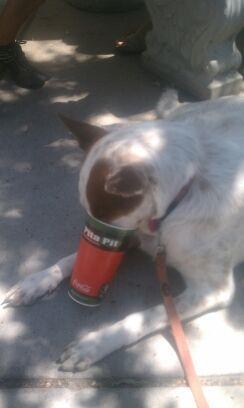
As always, Gnasher remains the cutest little monster out there.
Monday, June 11, 2012
Greetings from the Caribbean!
Hello everyone! I have been in the Caribbean for a little over a week now. I have been working hard brushing up on my sailing skills, preparing equipment, and exploring a lot of the places that I will be taking my students during the rest of the summer. Right now I am on an island called Saba. The picture is of the plane getting ready to land. The island is the tip of a volcano rising out of the sea and is very steep. The local people built a runway on the only bit of flat land they could find and it is the shortest commercial runway in the entire world! My first group of students arrives the day after tomorrow, and although I am very excited to meet them, having new students will make me miss all of you. I hope you are all having fabulous summer adventures and spending lots of time outside exploring!!! 

Monday, May 28, 2012
Public Service Announcements, Pt. 1
I think these videos are pretty awesome. Everyone did a really good job with this project! Let me know if you think they should be public (on youtube)!
Wednesday, May 16, 2012
Isa's Oxygen Lamp
Check this out!!! It looks like magic!!! Everyone ask Isa to explain how it works to you!!!
Monday, May 14, 2012
6th grade homework Monday May 14th
Your homework tonight is to do Lesson DD the rock cycle in your workbook, pages 167-169. Please underline and make the foldable. Answer the reading check and after you read questions.
Sunday, May 13, 2012
Happy Mother's Day!
Thank you to all the Salam Academy moms, step-mom, and grandmoms for raising such sweet and enthusiastic children! 
Friday, May 11, 2012
8th grade study guide
Materials:
Topics:
- Workbook pages 196-224
- Workbook pages 331-370
- Fish coloring packet
- Mammals coloring packet
- Grizzly Bear videos and student organizer
- Symbiosis videos and student organizers
- Class activities from this week
- Shark powerpoints
- Vocabulary quizzes
Topics:
- What is a chordate? What are the major characteristics that all chordates have at some point in their life? When do humans have a gill slits and a postanal tail? Are all chordates vertebrates? What are the major groups of vertebrates?
- What is a fish? What are the three types? How do fish get oxygen? How do fish keep from sinking or floating? How do fish prevent osmosis and dehydration?
- What are amphibians? What are different types of amphibians? How do amphibians breathe? What is special about amphibians in regards to environmental issues?
- What is a reptile? What is the largest group of reptiles? Why are reptiles important? Why can reptiles lay their eggs on land? What is environmental sex determination?
- Describe lift. How does it work? What animals use life? Birds and sharks.
- Describe major characteristics of birds.
- What makes a mammal a mammal? What are the different types of mammals? Examples of each?
- What are the major differences between sharks (cartilaginous fish) and bony fish like perch? Know at least 3.
- What is a living fossil?
- Why are top predators, usually animals that live a long time and become sexually mature late in life, especially important to ecosystems and especially vulnerable?
- Why are shark populations threatened and in some cases endangered?
- What are some of the issues surrounding grizzly bears in yellowstone park? Why did the grizzly population first decline? How did it first come back? What are some interactions between humans and bears now? Should grizzlies stay protected by the endangered species act? What do grizzlies eat? Why are they threatened now?
- What is symbiosis? Describe the different types? Which type is ++ +- +0 ? why is there not a --? give an example of each type.
- What is malaria? How is it transferred? What type of symbiotic relationship is it in?
- Describe what a biosphere, ecosystem, population, and habitat are.
- Describe competition and predation. Why are they not symbiotic relationships?
- What is a limiting factor? Examples.
- Explain carrying capacity. How are carrying capacity and limiting factors related? What is the carrying capacity of the earth for humans? What are limiting factors for humans on earth? How many humans are on earth now? When will we reach out carrying capacity? What is exponential growth? Describe it.
- How are producers and consumers different? What is a niche? How do niches decrease competition?
- What is an abiotic factor and a biotic factor? Important abiotic factors... How does latitude affect temperature and how does elevation affect temperature?
- What are the components of climate? How does climate affect life in an area?
- Describe the water cycle, the nitrogen cycle, and the carbon cycle.
- What are decomposers and why are they important to ecosystems. FBI. Give Examples.
- How do humans affect the nitrogen cycle? Oil is used to produce nitrogen fertilizers. Run off into rivers. Example dead zone in the gulf of Mexico.
- Chemosynthesis. Hydrothermal vents.
- Energy pyramids and trophic levels. Transfer of energy. How much energy is transferred up to each level? Why? Why are there very few top predators? Why do the biggest animals on the planet eat plankton?
- Biomes. Describe the major plants and animals and the climate of earths major biomes. Which do we live in? How do you know? Give examples of other places that are the other types of biomes.
- Aquatic ecosystems. What's the difference between a lake and a pond? What is an estuary? What is a wetland? Why are they super important? How are humans threatening these habitats?
- Rain shadow. What is it? How does it work? Where are they?
- Sampling technique. Why do scientists use sampling? Describe how it is used.
Thursday, May 10, 2012
Important Reminders (6,7,and 8th grade)
Hey everyone!
First: Tomorrow in science, we will be working on our PSA's and hopefully taping a few. If you need any supplies or props, please bring them.
The school year is quickly coming to an end. I know many of you are scrambling to get your grades up at the last minute. I appreciate that you care about your grades and want to improve them. I would like you to also appreciate that when everyone is handing in weeks worth of work in the last week of the semester, it creates a huge amount of work for me. I am grading and entering make-up work as fast as I can. The final date to hand in make-up work for 7th and 8th grade is Tuesday of next week The final day to hand in make-up work for 6th grade is Monday of next week. All grades must be entered by Thursday! Parent/teacher conferences are next Friday. Please be advised that I have class at 5:30 and will need to leave school by 5pm. If you can, try to schedule your conferences with me early in the day!
7th and 8th grade you have a really big science test on Monday... Please study over the weekend!!!
8th grade you have a 1 page (typed, single spaced, or 2 pages double spaced) report on what you have accomplished in helping to fix the environmental issue you researched. I hope to see that you have accomplished quite a bit!
In PE today, girls played a game called magic carpet. All the girls stood on a tarp, the "magic carpet," and tried to turn it over without having anyone stepping off. It is a quite challenging initiative and the girls didn't quite figure it out. It takes a lot of teamwork and excellent communication skills. If they had a little more time, they would have made it, I am sure!

 Also, aftercare is always a trip! Check out how absolutely adorable these two are together!!!! They are watching Toy Story 2 and sharing a chair! AWWW!


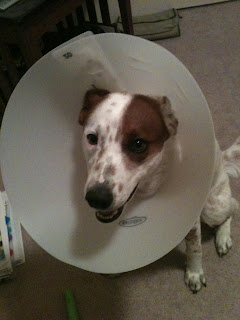
And this one is just plain funny. Gnasher would hate me if he knew I posted this one...
First: Tomorrow in science, we will be working on our PSA's and hopefully taping a few. If you need any supplies or props, please bring them.
The school year is quickly coming to an end. I know many of you are scrambling to get your grades up at the last minute. I appreciate that you care about your grades and want to improve them. I would like you to also appreciate that when everyone is handing in weeks worth of work in the last week of the semester, it creates a huge amount of work for me. I am grading and entering make-up work as fast as I can. The final date to hand in make-up work for 7th and 8th grade is Tuesday of next week The final day to hand in make-up work for 6th grade is Monday of next week. All grades must be entered by Thursday! Parent/teacher conferences are next Friday. Please be advised that I have class at 5:30 and will need to leave school by 5pm. If you can, try to schedule your conferences with me early in the day!
7th and 8th grade you have a really big science test on Monday... Please study over the weekend!!!
8th grade you have a 1 page (typed, single spaced, or 2 pages double spaced) report on what you have accomplished in helping to fix the environmental issue you researched. I hope to see that you have accomplished quite a bit!
In PE today, girls played a game called magic carpet. All the girls stood on a tarp, the "magic carpet," and tried to turn it over without having anyone stepping off. It is a quite challenging initiative and the girls didn't quite figure it out. It takes a lot of teamwork and excellent communication skills. If they had a little more time, they would have made it, I am sure!


Never leave your phone alone! Some paparazzi will pick it up and catch some pics when you are not expecting! I found these pics in my phone today and they made me laugh. I thought you might enjoy the laugh too!!


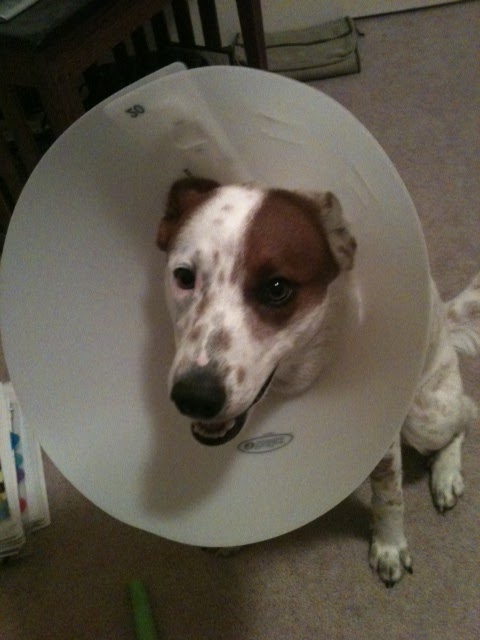
And this one is just plain funny. Gnasher would hate me if he knew I posted this one...
Wednesday, May 9, 2012
7th Grade Study Guide
Materials to study:
- The power point slides that I posted on the blog for you (mitosis, meiosis, mendelian genetics, and advanced genetics)
- Your notes that you took while I was giving the lectures that correspond to the above mentioned power-point slides
- The workbook, pages 77-100
- The videos posted on the blog, watch them again! They have a lot of great information.
- The cell division coloring packet and the DNA coloring packet
- Any homework, classwork, or quizzes that I have handed back to you.
- Neok12.com quizzes on cell division and genetics
- Why is mitosis important to single celled eukaryotic cells?
- Why is mitosis important to multi-celled organisms?
- What is interphase? It is part of the cell cycle, but not part of mitosis. What happens during interphase.
- List the stages of mitosis and what happens in each. Draw a picture of an animal cell in each of the stages.
- Mitosis is the division of the cell's nucleus. How does the cytoplasm divide?
- How many cells with how many chromosomes are produced at the end of mitosis?
- How many chromosomes do human body cells have?
- Can bacteria undergo mitosis? Why or why not?
- Why is sexual reproduction important to diversity, survival of species, and evolution?
- Where does meiosis happen in animals? In plants?
- Describe the stages of meiosis I and meiosis II. Which stage are the really important differences in? How many cells with how many chromosomes does meiosis I make? How many cells with how many chromosomes does meiosis II make?
- Why is it important for sex cells to have half as many chromosomes as body cells?
- What is the production of eggs called? How many eggs are made? What is the production of sperm called? How many sperm are made?
- What is independent assortment?
- What is crossing over?
- Who was Gregor Mendel? Why is he so famous? What did he do that others before him did not?
- What is meant by mendelian genetics? The study of traits coded for by one gene that exists as only 2 alleles with one dominant and one recessive. This is "simple" genetics.
- Punnett Squares! Practice. Be sure to be able to set up a cross and then determine the probably of an offspring having a certain genotype or phenotype.
- Advanced genetics: Polygenetic inheritance. What type of traits are coded for by many genes? Things that you see a range in; hair color, skin color, eye color, height.
- If given a data set, plot the data in a histogram and determine if the trait is likely to be controlled by more than 1 trait.
- Box plots.
- incomplete dominance, remember the flowers and the cows.
- Multiple alleles- Blood Type, A, B, and O. Can have genotype AO, AB, AA, BB, BO, OO and phenotype, A, B, O, or AB (A and B are codominant, O is recessive)
- DNA, what does it stand for? What is it made out of? Twisted ladder, the sides of the ladder are __________________ and the rungs of the ladder are ____________________________
- Where does DNA stay?
- What is RNA, what does it stand for? How is it different from DNA?
- What are the 3 types of RNA and what do they do?
- What are Amino Acids? the building blocks of proteins
- Practice coding from DNA to mRNA to tRNA to AA
- How are the different types of cells in our body different if they all have the same DNA?
- What can happen if the DNA in a body cell is damaged? Can this be passed on to babies?
- What happens if DNA in a sex cell is damaged?
Subscribe to:
Posts (Atom)